Reptiles and amphibians: Books about Snakes
If you want to buy a book, clicking on the book
cover will take you directly to that book on the Amazon.co.uk web site.
See also:
 Books
on lizards Books
on lizards
Books on tortoises, turtles and terrapins
Books on amphibians
Please click here for news and research on reptiles and amphibians, and here for general advice on snakes and lizards. |
 |
|
|
|
|
|
Click on the cover above
to go to this book
at Amazon.co.uk
|

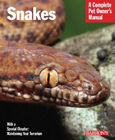
Snakes: Complete Pet Owner's Manual
R. D. Bartlett and Patricia Bartlett
Barron's Educational Series; 2nd Revised edition (1 Nov 2010)
ISBN-10: 0764143433
ISBN-13: 978-0764143434
This introductory guide to keeping snakes as pets is a classic which has been updated and revised. It is clear and easy to follow, and well-illustrated. It is an excellent starter book, and is clearly written enough for older children to understand. It offers better value for money than the 'Extreme Pets' guide to keeping snakes, though owners who have some experience of snakes are not likely to find much here they don't know. Owners also need to research types of snakes in greater depth before taking a decision on which to acquire, especially if they want to keep some of the larger snakes.
 Top
of page Top
of page
|
Click on the cover above
to go to this book
at Amazon.co.uk
|
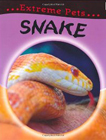
Snake: (Extreme Pets)
Julia Bird
Franklin Watts (8 July 2010)
ISBN-10: 0749696745
ISBN-13: 978-0749696740
On the plus side, this Extreme Pets guide to keepìng snakes as pets is an enjoyable read, and is popular with children because of its attractive layout. It is, however, a short book, and while it covers the basics, such as buying, feeding and handling a pet snake, and preventing and tackling health problems, the Bartletts' guide offers better value for money. This book is suitable for children in households where there are snakes, or for kids who just like snakes, but the main carer of a pet snake needs more in-depth information.
Top
of page
|
Click on the cover above
to go to this book
at Amazon.co.uk
|
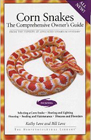
Corn Snakes: The Comprehensive Owner's Guide (Herpetocultural Library)
Kathy Love and Bill Love
Advanced Vivarium Systems; Reissue edition (15 Sep 2005)
ISBN-10: 1882770706
ISBN-13: 978-1882770700
This is a lovely introductory guide to keeping corn snakes as pets. It is clearly written, and, without overloading the reader with information, it provides help for new owners choosing and caring for their pet corn snakes, and has enough depth to interest experienced owners. In particular, there is fascinating information on the genetics of corn snake colours and patterns. The authors have developed their knowledge by breeding corn snakes, and have shared their expertise in a clear and interesting way. The book is also very well illustrated. Highly recommended, and a delight for both novice and experienced owners.
Top
of page |
Click on the cover above
to go to this book
at Amazon.co.uk |
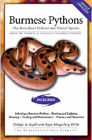
Burmese Pythons (Herpetocultural Library) [Paperback]
Philippe De Vosjoli
Advanced Vivarium Systems; Updated edition (Dec 2005)
ISBN-10: 1882770838
ISBN-13: 978-1882770830
Burmese pythons are very attractive snakes, and have become victims of their popularity. They are one of the reptiles which has caused most headaches when they have been abandoned by owners who had little idea of what they were taking on. These snakes are big when adult, often too big for owners to be able to house them, and they can be a threat to pets and wildlife if abandoned. Snake lovers really do need to think ahead, and plan what they are going to do when their pet grows too large for its current home. Philippe De Vosjoli addresses this issue, and provides help with choosing a python, and care, for example, feeding, providing the right environment, and preventing accidents. There is also guidance on preventing and tackling python health problems. The book is also well illustrated, and is worth looking at for the pictures alone.
Top
of page |
Click on the cover above
to go to this book
at Amazon.co.uk
|
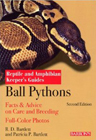
Ball Pythons (Reptile and Amphibian Keeper's Guide)
(Reptile and Amphibian Keeper's Guides)
R. D. Bartlett and Patricia Bartlett
Barron's Educational Series, 2nd Revised edition (1 Mar 2011)
ISBN-10: 0764145894
ISBN-13: 978-0764145896
Ball pythons are popular with snake keepers who have the space to house them. This book is a useful introductory guide to choosing and keeping ball or royal pythons, and is good value for money, but if you have taken the decision to acquire a python, you really need a guide that is a more in-depth.
Top
of page
|
Click on the cover above
to go to this book
at Amazon.co.uk
|
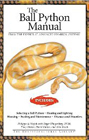
Ball Python Manual (Herpetocultural Library)
Philippe De Vosjoli Advanced Vivarium Systems, (Dec 2004)
ISBN-10: 1882770722
ISBN-13: 978-1882770724
Ball pythons are quite big, though not as large as some of the python family. They tend to be easy to handle once they have got used to contact with humans. They are also very beautiful snakes, so they are deservedly popular. However, they can suffer from stress, and refuse to eat. They may also wind themselves up tightly when they are scared, which is why they are called 'ball pythons'. They are long-lived snakes, so taking one on is a serious commitment. People wanting a ball python should read this book before acquiring a snake, it could make all the difference between a happy snake and owner, and a sick, stressed-out snake and worried owner. There is help with feeding, including reluctance to eat, gentle and firm handling, providing the right environment, and tackling and preventing health problems. There is also help with breeding, though serious breeders are likely to want more in-depth information.
Top
of page
|
Click on the cover above
to go to this book
at Amazon.co.uk
|
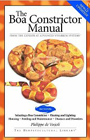
Boa Constrictor Manual (Advanced Vivarium Systems)
Philippe De Vosjoli Advanced Vivarium Systems;
Updated edition (21 Oct 2005)
ISBN-10: 1882770765
ISBN-13: 978-1882770762
Boa constrictors are big snakes, though not quite as big as Burmese pythons. They are quite easy to handle so long as you use common sense and don't spook them! Care should be taken with young snakes in particular. This guide gives you a lot of good advice on handling your pet snake, and all other aspects of care, and is especially useful for its treatment of infections and other health problems. There is also a lot of information on colour and pattern variations, which will interest people who are attracted by the beauty of boas. This book has enough depth to interest experienced boa keepers, and is clear enough for novices.
Top
of page
|
Click on the cover above
to go to this book
at Amazon.co.uk
|
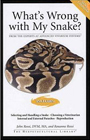
What's Wrong with My Snake? (Herpetocultural Library)
John Rossi and Roxanne Rossi
Advanced Vivarium Systems; New edition (May 2007)
ISBN-10: 1882770846
ISBN-13: 978-1882770847
This is a very handy reference book giving veterinary advice for snake keepers, which has been revised and updated. It covers behavioural issues like aggression, as well as physical problems like respiratory infection, parasite infestation, loss of appetite. The book is well structured, so it is easy to find what you are looking for in an emergency. It is also clearly written and the illustrations make it easy to follow. There are also charts for quick reference. It's a very useful reference book for both novice and experienced owners, though it cannot replace a good vet who specialises in snakes.
Top
of page
|
Click on the cover above
to go to this book
at Amazon.co.uk
|
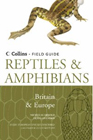
Collins Field Guide - Reptiles and Amphibians of Britain and Europe
Nicholas Arnold and Denys Ovenden
Collins; New edition (7 Oct 2002)
ISBN-10: 0002199645
ISBN-13: 978-0002199643
This book is the second edition of a classic, which was already the best guide to European reptiles and amphibians you could find, and which has now been expanded, with more species described, more pictures, and more help with identification. The new edition has been updated in line with the latest research. The distribution maps and illustrations are especially useful. There is also particular help with identifying spawn, and for those who are wary of snakes, there's a guide to the venom characteristics of different species of poisonous snakes. The book is conmprehensive enough for a professional biologist, and accessible enough for amateurs who are just interested in wildlife. A delightful book for nature lovers going on holiday in mainland Europe or the UK, or for anyone who just wants to check out their local herps.
Top
of page
|
Click on the cover above
to go to this book
at Amazon.co.uk
|
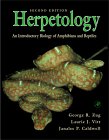
Herpetology: An Introductory Biology of Amphibians and
Reptiles
George Zug, Laurie J. Vitt, Janalee P. Caldwell
Academic Press
ISBN: 012782622X
A little pricey, but you get a lot of book for your money! This is thorough
enough for degree-level students, yet is accessible to the general reader
with an interest in herps. It is the second edition of a well-loved text,
which has been fully revised to bring it up to date and make it easier
to use. Anyone who likes herps will find it fascinating, and it is the
leading work in herpetology for biologists.
Top
of page |
See also:
Books
on lizards
Books on tortoises, turtles and terrapins
Books on amphibians
|


