Reptiles and Amphibians: General Articles
SUMMARIES OF ARTICLES ABOUT REPTILES AND AMPHIBIANS
We've given you two headlines, the first (in blue)
being the original, and the second (in red) aims to be a more informative
headline, so you can gain an idea of what the article is about more quickly.
The source is also given in case you want to track down the original article.
See also:
 Reptiles:
Health, disease and physiology Reptiles:
Health, disease and physiology
Books
on snakes
Books
on lizards
Books on tortoises, turtles and terrapins
Books on amphibians
Click here for advice on lizards and snakes
Click here for advice on tortoises and turtles
Click here for advice on amphibians
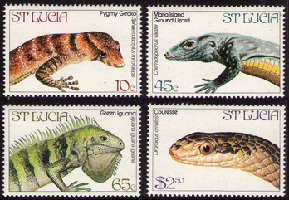 |
Please click on the picture for reptiles
and amphibians on stamps |

Drugs with bite
Medicines developed from venom from reptiles and other animals
source: James Mitchell Crow
New Scientist vol 214 no 2863, May 5th 2012
starts p34, 4 pages long
Research on the potential of animal venom as a source of medicines has intensified with the development of genomics. Pit viper venom, for example, affects blood pressure, giving rise to medicines for controlling blood pressure in humans. Snakes produce more venom than most invertebrates, and their venom contains fewer peptides, so they are easier to study, though medicines have also been develped from the venom of scorpions, snails and other invertebrates. Research on cobra venom dates back to the 1930s, and cobratoxin is a compound due for clinical trials to help people with MS, by depressing overactive immune responses. Another molecule, cobrotoxin, appears to have potential in preventing the spread of HIV. Meanwhile, Gila monsters produce a venom which has potential for treating type-2 diabetes.
RE,HH
 Top
of page Top
of page
Python invasion
Abandoned Burmese pythons threaten Florida wildlife
source: New Scientist vol 213 no 2850, February 4 2012, p5
Burmese pythons abandoned by their owners have had a serious impact on mammals in the Florida Everglades. Some mammal species have suffered declines of 99%, according to Michael Dorcas from Davidson College, North Carolina. He and his team recorded live and dead animals in Everglades roads from 2003 to 2011, and compared their findings with data from 1993 to 1999. Burmese pythons became a recognised Everglades species in 2000. Seriously affected species include raccoons, down by 99.3%, opussums, down by 98.9%, and bobcats, down by 87.5%. These species have not suffered declines in locations free from Burmese pythons. The US Fish and Wildlife Service has prohibited imports of Burmese pythons as well as transporting them from one US state to another.
RE,FR
Top
of page
The future's bright for warmer lizards
Global warming may help lizards by boosting their cognitive abilities
source: New Scientist vol 213 no 2847, January 14 2012 p15
Researchers from Sydney University, Australia, have found that lizards hatched from eggs incubated at warm temperatures learnt a task better than those incubated at cold temperatures. Scincid lizards grow bigger when they hatch from eggs incubated at higher temperatures. Joshua Amiel and team incubated nine eggs at between 8.5 deg C and 23.5 deg C, and 12 eggs at between 14.5 deg C and 29.5 deg C. The hatched lizards were placed in a container with two hideouts, one of which was inaccessible, being blocked with a transparent material. The researchers touched the lizards' tails, and recorded where they went. After 16 trials, five of the cold-hatched lizards still went towards the inaccessible hideout, while only one of the warm-hatched lizards did this.
RE,BT
Top
of page
Turtles' map holds if magnetic field drifts
Migration of loggerhead turtles
source: Anil Ananthaswamy
New Scientist vol 213 no 2846 January 7 2012 p10
Loggerhead turtles use the earth's magnetic field to help them navigate. Turtles hatch on Florida's coast, then move the the North Atlantic, where they stay for between six and twelve years in the North Atlantic Subtropical Gyre, a circular current, before going back to breed on North American coasts. North Carolina University's Ken Lohman and team set up a simulation of the coast of Portugal, and found that turtles changed direction in the simulated south coast, swimming south-west rather than south, which may help them escape predators off North Africa, though it takes them away from the gyre. However, at any simulated location, not all young turtles behave the same way. This variation in migratory behaviour may help the species to adjust to changes in the Earth's magnetic field.
RE,BT
Top
of page
Who are you calling slow?
Cognitive abilities of tortoises
source: Jeff Hecht
New Scientist vol 212 no 2844/2845, December 24/31 2011
starts p44, 2 pages long
Anna Wilkinson moved from studying bird cognition to studying reptiles. She studied the performance of a red-foot tortoise, called Moses, in a maze, and found that he used a cognitive map to retrieve food from arms of the maze not previously visited. The map was developed from objects outside the maze that were visible to him. When these objects were obscured, he became systematic in retrieving food from the arm next to the one previously explored. Previous reptile studies carried out at cool ambient temperatures had reported poor performance, but Moses was operating at a room temperature of 29 deg C, which meant he was more alert. In later research at Vienna University, Wilkinson found that one tortoise is able to follow the gaze of another. Tortoises can also locate hidden food by watching other tortoises find it. Tortoises, however, lack empathy, and do not learn to yawn by watching other tortoises do this. Wilkinson's work has triggered an interest
in reptile cognition, which can help to explain how animal intelligence evolved. New research suggests that animal intelligence has previously been underestimated. Wilkinson argues that natural selection for intelligence results from a high mortality rate for tortoises, which have to fend for themselves after hatching.
RE,BT
Top
of page
My love nest is bigger than his
Music frogs advertise burrows
source: New Scientist vol 212 no 2842, December 10 2011 p18
Male Emei music frogs, Babina daunchina, which live in central China, attract mates by singing about their burrows. Their calls from inside nests are longer and lower than normal calls. Their calls have been studied by Yezhing Tang and team from Chengdu's Chinese Academy of Sciences. The team played normal and nest calls to females, and discovered that more than 70% of the females approached the nest calls. Males of most species, apart from humans, tend not to advertise such resources, maybe because they could attract competitors who might take their resources.
AM,BT
Top
of page
Snake blood, a swell heart treatment
Snake fatty acids can help to boost the cardiac efficiency of mice
source: New Scientist vol 212, no 2837, November 5 2011 p19
Snake fatty acids can help to boost the cardiac efficiency of mice. Pythons increase heart size following a big meal. Human hearts can grow after blockages, and such growth can lead to scarring. Human hearts can also grow with exercise or in pregnancy, through release of IGF-1, a hormone. The same effect has been found in mice injected with fatty acids from snakes which had just been fed, according to Leslie Leinwand from Colorado University, Boulder.
RE,HH
Top
of page
Snake stores sperm for five years before giving birth
Rattlesnake gives birth from stored sperm after five years in captivity
source: New Scientist vol 212 no 2835, October 22 2011 p19
A rattlesnake has given birth in Florida after five years in captivity, and no contact with male snakes. She was captured in 2005 and gave birth in 2010. The DNA of the babies was found to be different from the mother's, according to Warren Booth from North Carolina State University, Raleigh. Snakes can reproduce with no male contribution, but the DNA differences indicate stored sperm.
RE,BR
Top
of page
Tree frogs supply their own water
Australian tree frogs cool to condense water from humid air
source: New Scientist vol 211 no 2829, September 10 2011 p17
Australian tree frogs emerge from tree hollows at night. This is surprising because it is colder at night, and colder temperatures usually make frogs more sluggish. Chris Tracey and his team from Darwin's Charles Darwin University, Australia, weighed the frogs, and discovered they increased their weight by 0.2 grams after returning to humid air in tree hollows. They had cooled their skin outside, so the moisture in the hollows condensed on the frogs, which could drink 60% of the water.
AM,FH
Top
of page
Animal magnetism
Turtles may use Earth's magnetic field when migrating
source: New Scientist vol 211 no 2826, August 20 2011 starts p34, 2 pages long
Loggerhead turtles may use the Earth's geomagnetic field when they are migrating. Young loggerheads appear to hatch with directions that ensure their first migration is always in warm water. They gradually develop a recognition of magnetic field lines, but it is not yet understood how the turtles can sense magnetism. Magnetic receptors, using magnetite crystals, may exist in the turtles' heads. Rainbow trout and salmon also appear to use the earth's magnetic field for migration, and may have magnetite in their noses. They may also use chemical detection of the magnetic field, through eye photopigments.
RE,BT
Top
of page
Cream slows snake venom's invasion
Nitric oxide cream can slow spread of snake bite venom
source: New Scientist vol 211 no 2819, July 2 2011 p16
Nitric oxide cream on the site of a snake bite can slow the spread of venom in the victim's blood supply. Dirk van Helden from Newcastle University, Callaghan, Australia, tried the cream on mice injected with snake venom. Bites penetrate tissue rather than blood vessels, so the lymphatic system is the main route for toxins entering the blood. The cream affects the lymphatic system by slowing pumping. Extra time can allow victims to seek help.
RE,HH
Top
of page
Python genes get frantic after meals
Dormant genes switched on in pythons after meals
source: New Scientist vol 211 no 2819, July 2 2011 p17
Burmese pythons do not often eat big meals, and they shrink most internal organs between meals. After meals the mass of their kidneys and hearts increases by a half, and that of their intestines is more than doubled. Todd Castoe and team, from Colorado University, Denver, took measurements of gene activity in these pythons, and found that some 1,800 dormant genes in python organs were turned on in the 24 hours following a meal. This genetic change is much greater than expected.
RE,HD
Top
of page
Nesting turtles fall victim to beetlemania
Beetles may be part of the life cycle of a nesting turtle beach
source: Catherine Branic
New Scientist vol 209 no 2797, January 29 2011 p13
La Escobilla beach, Mexico, is a major nesting site for sea turtles, and numbers have increased since the beach became protected in 1990. Turtle eggs and hatchlings are now threatened by hide beetles, which eat both. Only some 2% of eggs hatch each year. The turtles lay some 100 million eggs annually, and a mass egg-laying session is called an arribada. Ernesto Albavera from the Mexican Turtle Centre, Mazunte, sees beetle attacks as part of the life cycle of arribada beaches. Turtles return to their hatching place, and as fewer hatch, fewer return. New sites are adopted, though how this happens is not clearly understood.
RE,BR
Top
of page
Attack me if you dare
Defence mechanisms of amphibians and reptiles
source: Michael Marshall
New Scientist vol 208 no 2792/2793, 25th December 2010
starts p 63, three pages long
Many amphibians and
reptiles have very effective defence mechanisms. An example is the sharp-ribbed newt, which can punch out spears from tips on its ribs. The spears carry a toxin secreted onto the newt's skin. They penetrate the skin rather than using pores or holes. Meanwhile, the hairy frog, found in Cameroon, has retractable claws, brought out to slash enemies when needed. Spanish ladder snakes rotate and thrash their bodies to break off their tails. Some 20% of adults surveyed lacked a tail. Five-lined skinks shed their tails, which continue moving after separation, a distraction for predators. Poison dart froms from S America use toxins, and are brightly coloured to warn of their poison. Texas horned lizards shoot poison blood from their eyes. The poison comes from ants eaten by the lizards.
Meanwhile, Californian squirrels sometimes eat sloughed rattlesnake skin, and rattlesnakes are less interested in the smell of squirrel mixed with snake than in squirrel smell alone. Insects can also use surprising methods of defence, some of which involve the death of the insect to protect its colony.
RE,BC
Top
of page
Snakes' slit pupils help ambush prey
Vertical pupils help nocturnal snakes to hunt
source: New Scientist vol 207 no 2773, 14 August 2010 p18
Richard Shine from Sydney University, Australia, has found that nocturnal snakes are more likely to have vertical pupils, while round pupils are more typical of diurnal snakes. He looked at 127 species, luinking hunting behaviour and pupil shape. Snakes with slit pupils benefit from a deeper focus field, allowing them to keep still and maintain prey in focus. This helps nocturnal snakes to lie in ambush, while diurnal snakes tend to stalk prey.
RE,BC
Top
of page
Frog spawn knows how death smells
Embryo frogs can associate smells with predators
source: New Scientist vol 2000 no 2685 December 6 2008 p16
Researchers at Saskachewan University, Canada, led by Maud Ferrari, have shown that embryo wood frogs can associate smells with predators. The researchers exposed frogspawn to the smell of newts, by bathing it in water that the newts had previously occupied. Half the spawn was also exposed to crushed tadpoles in an infusion. After the eggs had hatched into tadpoles, those tadpoles which had smelled crushed tadpole with newt, reacted to a new exposure to newt smells by freezing - a way of defending themselves against predators. Those reptiles which had only smelled newt, without crushed tadpole, when they were eggs, did not freeze. The team later discovered that tadpoles need to associate the smell of newt with danger before they hatch, and cannot later learn this association
AM,BT
Top
of page
Look at me, I'm really scary
Lizards use press-ups to attract attention
source: New Scientist vol 200 no 2685 November 29 2008 p27
Harvard University's Terry Ord used a robotic lizard placed in a Puerto Rican forest, to understand why lizards do press-ups before making threat displays. The robotic lizard carried out threat displays both with and without the preliminary press-ups. The local lizards took little notice of the threats unless the robot had first carried out the preliminaries. This was especially true when there was little light, so press-ups appear to be a way of attracting attention.
RE,BT
Top
of page
Hard to swallow?
Reticulated python may be largest snake in the world
Source: John Aglionby
Guardian December 30 2003 p3
Officials from Curugsewu zoo, Indonesia, claim to have a reticulated python
that is 14.85 metres, or 49 feet long, which would mean that this is the largest
snake ever captured. The snake was found in Sumatra in 2002, and was reportedly
four metres longer, but part of the snake was cut off because it contained
undigested food, a rotting deer. The snake is fed on three or four dogs per
month. Reticulated pythons have been known to attack humans, but generally
prefer other food.
RE,BC
Top
of page
Is my baby safe from Tracy the python?
Escaped python presents little risk to humans
Source: Alok Jha
Guardian Life, June 26 2002 p2
A pet python which has escaped from its home in Sheffield, England, is not
seen as likely to present a risk for humans. Pythons lose their appetites
when they are cold, and this means that they are not likely to want to eat
outside heated enclosures in the UK. The python's owner has expressed concern,
but Chester Zoo's reptiles curator, Kevin Buley, notes that Pythons can go
for long periods with no food, and prefer to eat in familiar surroundings,
since they are unable to move after eating large prey. Pythons can still bite,
but their bite is not poisonous. The python is likely to be found asleep somewhere
dark, or she may venture onto tarmac after dark, since tarmac can retain heat.
RE,FR
Top
of page
Detection of leptospiral antibodies in caimans from the Argentine
chaco
Antibodies to zoonotic disease found in ranched caimans from
Argentina
source: C.A.Rossetti et al
Venterinary Record vol 153 no 20, November 15 2003
starts p632, 2 pages long
Antibodies to leptospirosis have been found in caimans from a ranch in Argentina,
where eggs from wild caimans are incubated. Antibodies were found in 67 caimans
of a total of 83 samples, or 81%. Other studies have identified reptiles as
harbouring leptospirosis, but no study has previously found antibodies to
this disease in the crocodile family. The caimans may have become infected
through the water supply, which came from an outdoor tank that was not covered.
Humans can suffer from leptospirosis, and further research is needed to assess
the significance of this finding.
RE,HH
Top
of page
Being watched
Rare leaf frog at Manchester Museum, England
Source: Guardian October 20 2003 p11
A rare lemur leaf frog from Costa Rica is thriving in Manchester, England.
The leaf frogs were found by the head of a vivarium, Andrew Gray, who imported
12 of the amphibians from Costa Rica. The vivarium is in Manchester Museum,
and is part of Manchester University. The frogs have bred successfully, and
there are 85 frogs at the vivarium. They are so rare in Costa Rica that they
were believed to be extinct.
AM,BC
Top
of page
Lizards like to keep it in the family
Australian skinks live in nuclear families
Source: Emma Young
New Scientist no 2386 March 15 2003 p20
Australian black rock skinks have been studied by Sydney University researchers,
who have found that they live in nuclear family groups, the only known reptile
to live as a stable nuclear family. The researchers studied 200 skinks from
New South Wales. They found that around 83% of groups with two or more adults
included a mating pair, while 65% of juvenile skinks were with one or both
parents, and some 66% of these youngsters lived with both parents.
Reptiles tend not to look after their children, but staying close to parents
can help a youngster avoid being eaten, since these skinks tend to eat unrelated
youngsters. Black rock skinks that survive to adulthood have an average lifespan
from 10 to 15-years-old.
RE,BR
Top
of page
Teenage mutant red-eared terrapins
British Chelonia Group concerned about abandoned terrapins
source:: Sharon Amos
Independent on Sunday Review February 23 2003 p27
The British Chelonia Group is concerned about pet terrapins abandoned in
the rivers, ponds, and canals. Thousands of red-eared terrapins were imported
from the southern US at the end of the 1980s and start of the 1990s. Abandoned
terrapins gradually starve, and can take five years to die. They are unable
to breed in the wild in the UK, but they can kill aquatic wildlife.
It is no longer legal to import these terrapins as pets. Unwanted pet terrapins
are airlifted to Italy by the British Chelonia Group (BCG), which charges
owners 25 pounds sterling for this service. They go to live in the Carapax
Sanctuary, Tuscany, The BCG has also devised a trap for terrapins in the wild.
It is useful for catching snapper turtles, which can be dangerous, as well
as for red-eared terrapins. Snapper turtles can bite off human fingers or
hands, but they are not often found as abandoned pets in the UK.
RE,AR
Top
of page
It shouldn't happen to a reptile
Reptiles abandoned by their owners in the UK
source: Sally Weale
Guardian G2 January 1 2003
starts p2, 2 pages long
Iguanas have become fashionable as pets in the UK, but they are not easy
to keep as they mature, and many are abandoned or given up to the RSPCA. Iguanas
can reach six feet in length, and need a lot of room as well as heating. Adult
male iguanas can also be aggressive. The RPSCA receives an annual average
of 370 calls relating to iguanas. Those that are abandoned can survive for
some time in the summer, but suffer when the weather turns cold.
The green iguana is the most popular as a UK pet, of the 600 or so types
of iguana. They are usually imported from Central America and Mexico at some
six month' old, and are attractive creatures, with vivid colours, between
six and eight inches in length. They have a strong mating drive, which becomes
apparent from the age of two-years-old, and they may try to mate with human
females, especially just before menstruation. Their mating tactics include
biting and scratching, which can be painful for women, and female iguanas
can be hurt.
The RSPCA uses specialist rescue centres, but there is not always enough
room for large iguanas, and they sometimes have to be put to sleep. Owners
may dump iguanas if rescue centres cannot take them, but this leaves the iguanas
to die a painful death from starvation, since they can only eat when they
are warm. Iguanas are able to dampen down their metabolisms, and this can
slow their heartbeats to just one beat per minute. This makes it difficult
to put them to sleep with barbiturates.
People like iguanas because they are exotic, but they are not suited to Britain,
and tend not to be given enough room in captivity.
RE,AR
Top
of page
The drug addicts, the pet shop boys and a tale of missing
toads
Stolen toads at risk and could poison thieves
source: Isabel Conway
Independent December 10 2002 p10
Three Bufo marinus, or South American cane toads, have been stolen from a
specialist pet store in Leeuwarden, Netherlands, and police fear that the
toads may be abused by drug addicts wanting to get high by licking the toads'
backs. The toads can grow up to 30 centimetres in length, and exude a venom
when frightened. The milky liquid can cause hallucinations, which is what
the addicts seek, but it is also a venom which can paralyse human hearts,
cause swollen tongues, and attack human nervous systems. There have been reports
that toads have been taken to drug addict hostels for the purpose of licking
them. This involves frightening the toads. Bufo marinus toads also need special
care, such as high humidity and warm daytime temperatures, so their lives
are at risk if they are kept by people ignorant of their needs.
AM,LW
Top
of page
Australia's plague ready to leap again
Cane toads threaten Kakadu national park in Australia
Source: David Fickling
Guardian November 22 2002 p22
Cane toads are threatening to take over Kakadu national park in Australia.
They came to Australia from Venezuela during the 1930s, and prey on local
wildlife. They have poisonous skin, so are not eaten by predators. Their expansion
in Australia has been rapid, especially in the north, where their territory
covers an estimated 400,000 sq miles. They are advancing towards the south
and west by an estimated 60 miles a year, colonising river valleys. They were
first introduced to Australia in an attempt to protect sugar cane crops from
pests, but the toads appear to eat anything but the grubs of the beetles that
attack sugar cane. Kakadu is a large national park, almost half as big as
Holland. Wildlife at risk include goanna sand monitors, turtles, snakes, and
quolls. Quolls are marsupials that look a little like foxes. Cane toads can
also kill crocodiles which try making a meal of a toad. Conservationists fear
that there may be no way to prevent the toads from predominating in the national
park.
AM,LW
Top
of page
Scientists find a hundred new types of frog lurking in the
forests of Sri Lanka
New tree frog species discovered by Boston University team
in Sri Lanka
source: Steve Connor
Independent October 11 2002 p11
Researchers from Boston University have discovered between 120 and 140 unidentified
tree frog species from Sri Lankan rainforests. Some of these frogs do not
have tadpoles, but their eggs turn into froglets. The eggs are laid on leaves.
This pattern could help explain why frogs in Sri Lanka appear to be doing
well, whereas frogs elsewhere have been affected by a decline. Frogs that
pass through a stage of being tadpoles may be more vulnerable.
A survey carried out in the same area a century ago found 100 species not
found by this recent research team, which suggests some could have become
extinct. The Sri Lankan rain forest has shrunk during this time.
AM,BC
Top
of page
Customs seizes crocodiles found in plane hold
UK customs seizes reptiles en route to Korea
source: Guardian July 15 2002 p9
UK customs officials have confiscated a large number of reptiles en route
to Korea. The haul included ten African dwarf crocodiles, which are endangered.
These crocodiles, which can reach 5 feet (1.5 metres) long are thought to
have been destined for Korea's pet trade. An additional 95 amphibians and
reptiles were confiscated, including 13 monitor lizards and 12 royal pythons.
The reptiles are thought to have come from Nigeria, and came with forged export
permits from Benin.
RE,LW
Top
of page
Snap, crackle and hop
Frogs take flight when they hear fires crackle
source: New Scientist May 11 2002 p27
Researchers from Wurzburg University, Germany, have discovered that frogs
react to the sound of fire. They set up speakers in a national park on the
Ivory Coast, and played different sounds to frogs, including savannah fire
sounds and white noise. Juvenile reed frogs looked up and around on hearing
the sound of fire, and rapidly made their way towards vegetation that was
fire-resistant.
AM,BT
Top
of page
Presence of Salmonella infections in freshwater turtles
Research on salmonella in different species of turtles,
and risks to humans
source: F Pasmans et al
Veterinary Record vo150, no 22, June 1 2002
starts p692, 2 pages long
Turtles appear to carry Salmonella while showing no clinical signs, so they
present a risk to humans, who can contract Salmonellosis. Commercial turtle
farms seek to combat this risk by decontaminating eggs of turtles, but there
are still large numbers of juvenile turtles exported with Salmonella infections.
Most studies involve ornate terrapins, notably red-eared terrapins, since
they have economic importance. This study seeks to assess the prevalence of
these infections in several freshwater turtle species, as well as the risk
of a serovar Muenchen turtle isolate being transmitted to homeothermic creatures.
The study used 62 turtles from four private owners and 10 pet shops. Samples
were either swabs from the soil of aquaria (34 samples) or cloacal swabs (28).
The genera included Apalone, Chelydra, Chinemys, Emys, Emydura, Geomyda and
Kinosternon. Seven samples were found to be positive, or 11.3%, with three
coming from cloacal samples, and four from soil samples. Six serovars were
found from I, II and IIb subspecies. Five mice and five chicks were infected
using by oral transmission, using S Muenchen from a red-eared terrapin. One
mouse died, and the caeca of the other mice and five chickes tested positive
for the serovar, while the spleens of two chicks and one mouse were also infected,
as was the liver of one mouse. It appears, then, that serovar Muenchen from
reptiles can invade birds' and mammals' intestinal tracts.
Most of the isolates came from ornate terrapins that were farm bred, and
it is these species which have been subject to preventive measures, do not
appear to be totally effective. The seven isolates were from three subspecies
of Salmonella enterica, with six different serovars. Turtles have relatively
low infection tates, but they can act as a reservoir of Dalmonella serovars
that have potential as pathogens for homeothermic animals.
RE,HH
Top
of page
Wildlife TV puts snake charmers on endangered list
Indian snake charmers hit by competition from TV wildlife
programmes
source: Luke Harding
Guardian April 4 2002 p16
Indian snake charmers are finding it harder to earn a living, and see this
as linked to competition from TV wildlife programmes. These programmes mean
that spectators no longer fear wild animals, according to chief snake charmer,
Babu Sri Ram Nath.
Most Indian snake charmers come from a hereditary caste, the sapera, based
in Salenagar, a small village in the North of India, an hour from Lucknow
in a car. The snake charmers’ ancestors came from Bengal, some 200 years
ago.
Muscial tastes in India have also changed as a result of Bollywood’s
influence, Nath argues, and this also means that young people are less attracted
by the snake charmer’s act, with its traditional music.
The sapera are seeking recognition as a scheduled caste, in order to qualify
for privileges such as government employment. Many snake charmers see their
work as a way to earn a living, and are not fond of snakes.
RE,PI
Top
of page
Exotic pets suffer lingering deaths
RSPCA concerned about trade in reptiles as pets
source: Paul Brown
Guardian March 13 2002 p9
The RSPCA is concerned about trade in reptiles as exotic pets, since many
new owners do not know how to look after them. The RSPCA wants a ban on importing
some species that are difficult to care for. Almost 25% of the imported reptiles
are dead when they arrive at the importers.
Some reptiles can grow to be very large. Spectacled caimans can reach nine
feet, and live to be 100-years-old. Monitor lizards can reach over six feet
and are able to eat dogs and cats. Species growing as large as this are often
dumped, but most die before they grow large. Reptiles have been found with
rickets, lamp burns, and rotting limbs and mouths.
The UK represents one of the biggest EU markets for exotic reptiles. Over
the last decade, the EU has imported 176,000 chameleons, 80,000 monitor lizards,
and 28,000 crocodiles, all under license. There are also cases of reptiles
smuggled into Britain.
Space and diet are serious problems. Pet shops may give the wrong advice.
Terrapins and tortoises tend not to have big enough enclosures, and this applies
to over half of snake tanks and enclosures.
Reptiles may also bite, and bites can transmit infection, while some are
venomous.
RE,LW
Top
of page
French run scared of marauding frogs
Californian bullfrogs in south-western France
source: John Lichfield
Independent April 3 2001 p13
Giant Californian bullfrogs are causing problems in south-western France.
They came to the Gironde region illegally some two decades ago, and can eat
small birds, as well as lizards, fish and frogs. Christophe Coic from Cistude,
an environmental group, is among those concerned. He sees indigenous species
as under threat from the bullfrogs, and Cistude is seeking to eradicate them.
Meanwhile, the fisheries protection association of the Gironde once sought
to attack bullfrogs in a pond, using electric poles, and found that the frogs
defended themselves. Only one frog died after a two-hour battle.
AM,BC
Top
of page
Operation turtle rescue
Brazilian project to protect turtles
source: Steve Connor
Independent Review January 25 2002 p8
Project Tamar is a Brazilian project to help endangered sea turtles, and
its full name is the National Maritime Turtle Conservation Programme of Brazil.
Tamar has funding from a non-governmental organization called Foundation for
Tamar, and the Brazilian Environment Institute. There are over 20 Tamar centres
on Brazil’s Atlantic coast, where local people help promote eco-friendly
tourism. Local people had previously eaten turtles and taken their eggs. Laws
banning this could not work unless locals could be persuaded that turtles
brought them benefits. The project has lasted 21 years, and some turtle populations
have stabilised, with a few even rising in that time. There has been a focus
on educating children through a kindergarten, set up by Tamar. The children
can earn money from helping tourists as guides. Their parents also see the
value of turtles as a way of attracting tourists, whose spending helps local
people to earn a living.
Fishermen have also helped with turtle conservation, by locating nests that
need protection, some of which may be moved to better locations. Eggs need
to be moved fast from poor locations for a good success rate in terms of hatchings,
so the fishermen’s help is very important.
Some species, such as hawksbill and loggerhead turtles, have a majority of
females among hatchlings. It is unclear why this is so. Proportions of females
seem to increase when the water is warmer, and females may also be more likely
to die before adulthood than males.
The Marine Turtle Research Group is based in Swansea, and is under the University
of Wales. Brendan Godley is a researcher there who has worked with Brazilian
researchers on turtle navigation. There is much about turtle migration that
has yet to be understood, but it is clear that turtle conservation is an international
issue, since they migrate across national boundaries.
RE,LW
Top
of page
Save the turtle
Recovery plan agreed in Asia to protect turtles
source: New Scientist July 7 2001 p19
A number of countries in South-East Asia and bordering the Indian Ocean have
agreed on a plan to help sea turtles to recover in numbers. The species include
flatback, hawksbill, green, and loggerhead turtles. They are threatened by
hunting, getting entangled in fishing nets, and habitat destruction. The aim
is to curb these threats, educate the public, and promote scientific exchanges
on turtles.
RE,LW
Top
of page
Randy reptiles
Male dragon lizards spend longer mating with females
they have seen mating another lizard
source: New Scientist May 12 2001 p25
A researcher from the University of Gothenburg, Sweden, Mats Olsson, has
found that male dragon lizards spend longer mating with female lizards they
have observed mating with another lizard, in comparison with females they
have not observed mating. This may be in order to boost the male lizard’s
chances of being the father of the female’s offspring.
RE,BR
Top
of page
New York’s runaway reptile captured
Cayman captured in Central Park, New York
source: David Usborne
Independent June 23 2001 p5
A cayman has been captured in Central Park, New York, a few days after it
was spotted there. The South American spectacled cayman was caught by alligator
wrestlers, Tina and Mike Bailey, who had to work with camera lights trained
on them, since the case had been given a lot of publicity. The cayman may
go to a zoo, or be taken back to the wild in South America. It was only two-feet
long, but may grow up to eight feet as an adult.
RE,LW
Top
of page
Deadly snakes worth 30,000 pounds sterling seized
Poisonous snakes seized in Plymouth, England
source: Terri Judd
Independent May 10 2001 p10
Police have raided two houses in Plymouth, England, and have found 29 poisonous
snakes, as part of an operation to tackle the buying and selling of endangered
species. The black market value of these snakes has been estimated at 30,000
pounds sterling, and it is believed they were offered through the internet.
The raids were carried out under the Control of Dangerous Species Act. The
snakes include Gaboon vipers, Rattlesnakes, Eyelash and Rhinocerous vipers,
and Emerald tree pythons.
RE,LW
Top
of page
Lucky’s last croak
Extinct Norfolk pool frogs were native species
source: Gail Vines
New Scientist January 12 2002
starts p42, 2 pages long
Brown pool frogs found in Norfolk, England, were similar to Scandinavian
frogs, and were not introduced to Norfolk from Belgium and France, as was
previously thought. Some European water frogs were introduced by landowners
during the 19th century, but Norfolk pool frogs now appear to have a longer
history in Britain. These frogs appear to have survived the ice age and to
have arrived in Britain some 10,000 years ago, prior to the formation of the
North Sea some 8,000 to 9,000 years ago. The last Norfolk pool frog died in
1999. DNA analysis has been carried out of 19th century Norfolk pool frogs
from samples stored in the Natural History Museum, and this links pool frogs
to those in Scandinavia. Sound recordings of pool frogs made in the 1980s
also indicate that Norfolk pool frogs were similar to those of Scandinavia.
Their croaks were loud, and they were once called ‘Cambridgeshire nightingales’.
Bones from what appear to be pool frogs have been found which date back to
the period from AD 800 to AD 1000.
AM,BC
Top
of page
Island hopping
Ranid frogs may have originated in India
source: Jeff Hecht
New Scientist April 14 2001 p10
Ranid frogs may have originated in India, and remained there for 60 million
years, researchers from the Free University of Brussels believe. Ranid frogs
account for a fifth of amphibians world wide. They are thought to have evolved
in India some 120 million years ago, at a time when India was an island, so
they were unable to reach other land masses. Around 90 million years ago,
Madagascar separated from India, and frogs would have been on Madagascar.
Some 60 million years ago the Eurasian and Indian plates collided, allowing
frogs to spread to the mainland.
The researchers reached these conclusions following a study of DNA sequence
differences between different frog species. Such differences can provide a
molecular clock, if there are constant rates of genetic change. The clocks
allow scientists to tell when divergence of populations occurred. Dating from
molecular clocks may differ from dating based on fossil evidence.
Scientists previously thought that frogs spread to India from Africa or Asia.
Mammals and birds may also have come from India, which may explain why fossil
evidence indicates younger ages than those calculated from molecular clocks.
There is no certainty, however, that evidence from frogs can be applied to
mammals and birds.
AM,BC
Top
of page
Lilliputian lizard
New lizard species may be smallest reptile in the world
source: New Scientist December 8 2001 p27
Sphaerodactylus ariasae is the name of a new lizard species discovered on
a Caribbean island by researchers from Puerto Rico and Pennsylvania State
universities. A full-grown lizard of this species is only 1.6 centimetres
long. It is as small as the species listed in the Guinness Book of Records
as the smallest reptile in the world, S. partenopion, found in the British
Virgin Islands.
RE,BC
Top
of page
Don’t eat me, I’m covered in vomit
Grasshoppers defend themselves from green anoles by vomiting
source: New Scientist April 21 2001 p23
A researcher from Northern Plains Agricultural Research Laboratory, Montana,
Greg Sword, has discovered that grasshoppers consume wafer-ash leaves, then
vomit on themselves, as a way of defending themselves against green anole
lizards. Insects covered in this vomit are spat out by the anoles. Some insects
produce their own toxins as a defence, but these grasshoppers’ defence
is dependent on the type of plant that they have consumed.
RE,FH
Top
of page
Chef’s special
Turtle studied by conservationists is eaten in barbecue
source: Eric Niiler
New Scientist August 11 2001 p17
Wildcoast, a conservation group from San Diego, had tracked an East Pacific
green turtle weighing 110 kilograms, from December 2000 to March 2001, while
the turtle swam from southern Mexico to Baja California on the Pacific coast
of Mexico. The signals ceased in March, and the turtle was later found to
have been eaten at a barbecue attended by some 100 people villagers. Schoolchildren
had been observing the adventures of the turtle, through the internet. Mexican
law protects sea turtles, but the law is not strictly enforced, and green
turtles are also seen as a good source of meat. An estimated 30,000 green
turtles are consumed annually in Baja California Sur. The transmitter cost
2,500 US dollars, and Wildcoast is hoping to get it back.
RE,LW
Top
of page
Frog homes off the market
Mail order company withdraws homes for tadpoles
source: The Animals' Agenda March-April 2000 p11
A mail order company. Mindware, has withdrawn a terrarium kit for tadpoles to be raised into frogs. The company had not considered what would happen to the frogs after they became adult. The product was withdrawn in January 2000 after complaints from consumers.
AM,PI
Top of page
RSPCA raids expose trade in deadly wild animals
Concern over dangerous reptiles kept in unsuitable conditions
source: Severin Carrell
Independent November 17 2000 p11
There is concern about dangerous species being kept as pets in Britain, either illegally, or in inadequate conditions. RSPCA raids have uncovered puff adders and other dangerous snakes kept in Sheffield, and an alligator housed in a bedroom in Chesterfield. The alligator, five foot long and called Louis, had come from the US to be sold to a zoo, and was then bought by a pet shop, which sold it on. Meanwhile, a man who bought what he thought was a lizard, in a pub in Essex, England, found he had bought a caiman, which grows to seven feet. A hatchling anaconda was purchased by a Basingstoke teenager. The RSPCA wants anacondas and other constricting snakes to be included among wild animals legally defined as dangerous in Britain, and wants stricter controls of licence holders who keep such animals.
RE,LW
Top of page
Look out, there's a python about
Increase in pet snakes abandoned in Britain
source: Robert Mendick
Independent on Sunday February 20 2000 p10
Police forces in Britain have had to learn how to handle giant pythons and boa constrictors, after a rise in the number of pet snakes abandoned by their owners. The RSPCA is seeking a change in the law regulating exotic pet sales. Pythons can be bought for as little as 40 pounds sterling, and can grow from 18 inches to 20 feet. Reptile Trust chief executive, Peter Heathcote, estimates some 2,000 abandoned animals annually. The number of cruelty convictions relating to exotic pets rose to 126 in 1999 from 58 for 1998. Children could be endangered by a python or a boa constrictor, and toddlers have been killed by them in the US. The Reptile Trust plans a number of new centres in Britain. An RSPCA spokeswoman notes that it is illegal to release a member of a species not indigenous to Britain, according to the 1981 Wildlife and Conservation Act. Owners with problems can seek help from the RSPCA.
RE,LW
Top of page
Italians seize 20,000 banned tortoises
Endangered tortoises illegally imported into Italy from US
source: Guardian August 10 2000 p15
A cargo of 20,000 endangered red-cheek tortoises, a few days old, has been found by Italian police at Rome airport, Italy. The tortoises were illegally imported from Louisiana, and had been purchased by a wholesaler in Turin, Italy, who may be prosecuted. The tortoises are to go to a WWF sanctuary.
RE,LW
Top of page
Gecko farmers could save the wild bunch
Herpetologist seeks to promote gecko farming in Vietnam
source: Philip Cohen
New Scientist September 9 1995 p8
Herpetologist, Bob Murphy, from Canada's Royal Ontario Museum wants to promote gecko farming in Vietnam. He travelled to Vietnam to record new reptile species, and discovered that tokay geckos are an important source of income for villagers. They are used in traditional Asian medicines, and there is a very large market for geckos. Murphy found that wild geckos were becoming scarce. Community farming of geckos could both help the environment and local economies. Captive geckos breed well, and geckos farmers might change their attitude to wild geckos, seeing them in terms of conservation rather than harvesting.
RE,HH
Top of page
Warning over exotic pets after lizard kills baby
Baby dies after being infected with salmonella caught from family pet reptile
source: Cherry Norton
Independent February 24 2000 p4
British chief medical officer, Professor Liam Donaldson, has stated that the aged, pregnant women, and children of less than five years of age should not have contact with reptiles. This follows the death of a three-week-old baby from salmonella poisoning. The baby had been infected by a pet water dragon kept by the family. There were 258 cases of salmonella linked to reptiles in 1999, a rise from 198 cases in 1998. Nine tenths of reptiles are thought to carry salmonella. Humans do not usually suffer seriously from infections caught from reptiles, but there may be complications like septicaemia and salmonella meningitis. The bug is shed in the droppings of terrapins, lizards, snakes and other reptiles.
RE,HH
Top of page
Highway panic as snake legs it to freedom
Corn snake escapes from pet shop into family's car
source: Esther Addley
Guardian October 18 2000 p13
A family from the Midlands, England, who bought dog shampoo and fish tank equipment at a pet shop later found that they had come away with a corn snake in their carrier bag. The snake came out of the bag when the family was driving home, and it began to climb up the driver's leg. He fled from the car with his wife and two children. A passing police armed response unit came to the rescue. Corn snakes come from the south eastern US and live on birds and rodents. They are not poisonous.
RE,FR
Top of page
Reptile experts called in to locate alligator in Newcastle park
Alligator reported in park in Newcastle, England
source: Ian Herbert
Independent March 1 2000 p7
Visitors to Heaton Park, Newcastle-upon-Tyne, England, report having seen a six foot alligator. Reptile experts believe this could be a caiman alligator, native to South America, and often sold as an exotic pet. Peter Heathcote, director of the Reptile Trust, advises the public not to approach the alligator, but to contact the trust. Three small three foot long alligators were found abandoned across Tyneside in summer 1999. The new alligator could be part of that batch, after having grown. Joggers are not considered to be at risk from the Heaton Park alligator, according to a wildlife liason officer for the police.
RE,FR
Top
of page
See also:
Reptiles:
Health, disease and physiology
Books
on snakes
Books
on lizards
Books on tortoises, turtles and terrapins
Books on amphibians
|


