Books on Animals
Reptiles and amphibians: Books about turtles, terrapins
and tortoises
If you want to buy a book, clicking on the book
cover will take you directly to that book on the Amazon.co.uk web site.
See also:
 Books
on lizards Books
on lizards
Books on snakes
Books on amphibians
Click
here to see some stamps with tortoises and turtles on
Please click here for news and research on reptiles Please click here for advice on keeping tortoises, turtles and terrapins |
 |
|
|
|
|
|
Click on the cover above
to go to this book
at Amazon.co.uk |

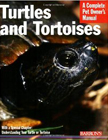
Turtles and Tortoises (Complete Pet Owner's Manual)
Richard Bartlett and Patricia P. Bartlett
Barron's Educational Series Inc.,U.S.;
2nd Revised edition (27 Oct 2006)
ISBN-10: 0764134000
ISBN-13: 978-0764134005
This is the second edition of a short guide to choosing and caring for pet turtles and tortoises. There is background information on the lifestyle of the tortoise family in the wild, to help pet owners understand chelonian needs, especially their housing and feeding needs. There are also accounts of different species. This is an especially good book for children, because it's so clearly written and well set out. It is good value for money, though the 'For Dummies' general guide offers more information. Though this book gives you a good overview of turtles and tortoises, it is also worth supplementing this general guide with a more specific guide to the type of tortoise or turtle you own or plan to buy.
 Top
of page Top
of page
|
Click on the cover above
to go to this book
at Amazon.co.uk
|
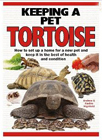
Keeping a Pet Tortoise
A.C. Highfield, Nadine Highfield and Philip de Ste. Croix
Interpet Publishing (15 Mar 2009)
ISBN-10: 1842862138
ISBN-13: 978-1842862131
Andy and Nadine Highfield have some thirty years experience with tortoises. They are well known for their work with the Tortoise Trust, and are concerned about tortoises in the wild, as well as pet tortoises. This book helps readers to understand tortoises in their natural environment, and threats to their survival, including those posed by the pet trade. It goes beyond simply providing guidelines for tortoise care, and helps buyers to take responsible decisions on choosing a tortoise, so that protected species are not placed under further threat. Different tortoise species are described, with photos, and their information on their natural habitats is helpful for owners wanting to recreate a suitable environment for their pet tortoises. There is a lot of help with diet, an area which is often neglected by novice owners who allow their tortoises to wander round their gardens and hope that and a bit of lettuce now and then is enough. There is also help for owners wanting to keep their tortoises indoors, both with feeding and housing. The section on hibernation is especially useful for novices. The book also provides some information on breeding tortoises, though owners wanting to breed their pets probably need more specialist help. In general, this book is likely to be of most use to a novice, though anyone who likes tortoises will find it interesting for the photoes and the information on the natural history of tortoises.
Top
of page
|
Click on the cover above
to go to this book
at Amazon.co.uk
|
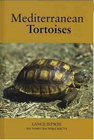
Mediterranean Tortoises
Lance Jepson
Kingdom Books,Havant (1 Mar 2006)
ISBN-10: 1852792299
ISBN-13: 978-1852792299
Mediterranean Tortoises have long been kept as pets in the UK, and were once taken for granted. Nowadays owners are more aware that our climate can be something of a drawback if you want to keep Mediterranean tortoises healthy. This book is especially useful for its help with overcoming the effects of our cooler, rainier climate on your pet, by providing the right sort of housing. As one would expect from a tortoise care guide, the book also provides help with feeding and hibernation. It is especially useful for novices who want to understand the particular needs to Mediterranean tortoises.
Top
of page
|
Click on the cover above
to go to this book
at Amazon.co.uk
|
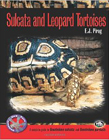
Sulcata and Leopard Tortoises (Complete Herp Care)
E. J. Pirog TFH Publications; 1st edition (24 Nov 2008)
ISBN-10: 0793828988
ISBN-13: 978-0793828982
Sulcata and Leopard Tortoises are popular as pets because they are quite big, and often have interesting patterns. They are also fascinating to observe. They come from Africa, and owners need to plan ahead to set up the right environment before acquiring a pet Sulcata or Leopard tortoise. This book provides a great deal of information on choosing and caring for a Sulcata or Leopard, and it is accessible enough to interest older children. This is probably the best introductory guide around to these fascinating tortoises.
Top
of page
|
Click on the cover above
to go to this book
at Amazon.co.uk
|
Russian Tortoises (Complete Herp Care Series)
E. J. Pirog TFH Publications,U.S. (Sep 2006)
ISBN-10: 0793828821
ISBN-13: 978-0793828821
Russian Tortoises are quite small, and are related to other species such as Egyptian, and Hermann's tortoises, so the information in this guide is also relevant to them. Russian tortoises need particular care in terms of diet and housing. This guide helps you to set up the right environment for your tortoise, and gives help on other aspects of caring for your pet. The book is very accessible, and well organised, so it is easy to find the information you need. It is of most help for a novice thinking of acquiring a Russian tortoise, though it is likely to appeal to anyone who likes tortoises.
Top
of page
|
Click on the cover above
to go to this book
at Amazon.co.uk
|
Aquatic Turtles (Complete Herp Care Series)
David T. Kirkpatrick TFH Publications,U.S.; 1st edition (Nov 2006)
ISBN-10: 0793828856
ISBN-13: 978-0793828852
Aquatic Turtles is an excellent introduction to turtles and terrapins. It deals with both caring for turtles and terrapins as pets, and their lives in the wild. The book is geared to an American readership, but it is interesting for British readers to learn about American wildlife. The photos are especially good, the book is clearly written, and is very accessible to older children as well as to adults. This is a book that is likely to appeal to anyone interested in exotic wildlife, as well as people wanting to know how to care for a pet turtle, because of the information the book gives on a wide range of species of aquatic turtles, including painted turtles and red-eared sliders.
Top
of page
|
Click on the cover above
to go to this book
at Amazon.co.uk
|
Medicine and Surgery of Tortoises and Turtles [Hardcover]
Stuart McArthur (Editor), Roger Wilkinson (Editor), Jean Meyer (Editor)
Wiley-Blackwell (11 Feb 2004)
ISBN-10: 1405108894
ISBN-13: 978-1405108898
This is a very pricey book, but is well worth investing in if you are a vet. It is also useful if you are a serious enthusiast with several tortoises and turtles, especially if you want them to breed. It is also like to be useful for someone who works with tortoises and turtles at a zoo, or is involved in chelonian research and conservation. There is simply no other reference book which is as well-researched and provides as much information on Tortoise and Turtle health care and management. The book is written by an international team of chelonian veterinarians, and covers conservation, nutrition, husbandry, anatomy and physiology, as well as more strictly medical topics such as diseases and their diagnoses, anaesthesia, and surgery. It is very well illustrated, with more than 1,000 photographs, which can help with diagnoses and husbandry. There are also illustrations and charts, which help to make the information very accessible. The presentation of the book as a tough hardback also means that it is likely to survive decades of use, and it is unlikely that any individual or team will top this book for some time, because of the sheer amount of research and care with presentation that has gone into Medicine and Surgery of Tortoises and Turtles.
Top
of page
|
Click on the cover above
to go to this book
at Amazon.co.uk
|
Turtles: An Extraordinary Natural History 200 Million Years in the Making
Carl J. Franklin Motorbooks International (15 July 2007)
ISBN-10: 0760329818
ISBN-13: 978-0760329818
Carl Franklin's book is a fascinating account of the turtle family, which includes tortoises. It is informative enough to interest biologists, and accessible enough to interest young readers. It is of especial interest to people who keep turtles and want to know more about them. Franklin explains how turtles evolved, their role in ecosystems, turtle behaviour, and more. One problem that turtles face is demand from the pet trade, so it is worth thinking about where a turtle comes from before you consider buying it. There are over 300 known species of turtle which live in a wide range of environments, from the sea to the mountains. Obviously it helps pet owners to understand the needs of their pet better by understanding how the animal lives in the wild, but this book is a good read in its own right. It is likely to interest anyone who likes reptiles. There is useful contact information for people wanting to find out more, or get involved in conservation. The book is well illustrated, and the author is obviously enthusiastic about his subject - a real treat, and highly recommended.
Top
of page
|
Click on the cover above
to go to this book
at Amazon.co.uk
|
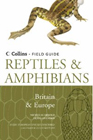
Collins Field Guide - Reptiles and Amphibians of Britain and Europe
Nicholas Arnold and Denys Ovenden Collins; New edition (7 Oct 2002)
ISBN-10: 0002199645
ISBN-13: 978-0002199643
This book is the second edition of a classic, which was already the best guide to European reptiles and amphibians you could find, and which has now been expanded, with more species described, more pictures, and more help with identification. The new edition has been updated in line with the latest research. The distribution maps and illustrations are especially useful. There is also particular help with identifying spawn, and for those who are wary of snakes, there's a guide to the venom characteristics of different species of poisonous snakes. The book is conmprehensive enough for a professional biologist, and accessible enough for amateurs who are just interested in wildlife. A delightful book for nature lovers going on holiday in mainland Europe or the UK, or for anyone who just wants to check out their local herps.
Top
of page
|
Click on the cover above
to go to this book
at Amazon.co.uk
|
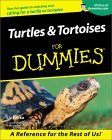
Turtles and Tortoises for Dummies (For Dummies)
Liz Palika
Hungry Minds Inc
ISBN: 0764553135
Easy to follow, and very good value for the amount of information it
contains. This is an excellent guide for novices who are interested in
all the tortoise family. They should read it before getting their first
specimen, or buying new ones - there is some very useful advice on the
relative difficulty of different species. Liz Palika is a well-known US
specialist in reptiles, and the book is geared to US readers, but it is
packed with so much information that we could forgive her for being American.
Top
of page
|
Click on the cover above
to go to this book
at Amazon.co.uk
|
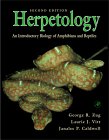
Herpetology: An Introductory Biology of Amphibians and
Reptiles
George Zug, Laurie J. Vitt, Janalee P. Caldwell
Academic Press
ISBN: 012782622X
A little pricey, but you get a lot of book for your money! This is thorough
enough for degree-level students, yet is accessible to the general reader
with an interest in herps. It is the second edition of a well-loved text,
which has been fully revised to bring it up to date and make it easier
to use. Anyone who likes herps will find it fascinating, and it is the
leading work in herpetology for biologists.
Top
of page |
See also:
Books
on lizards
Books on snakes
Books on amphibians
Click
here to see some stamps with tortoises and turtles on
|


