News and research
Goats, Sheep, Pigs and other Cloven-Hoofed Animals: Health,
Disease and Physiology
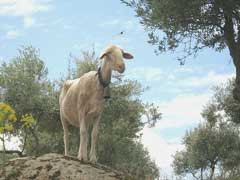
Kirsty, a very bold and friendly sheep.
Kirsty is a Manchego cross, a big, rangy breed from central Spain. She has just been shorn, and is also an old lady, for a sheep, which is why she differs from fluffy English sheep on postcards. Kirsty is the one sheep from her flock who comes up to the shepherd if supper is a little late of an evening, enquiring whether he is going to provide her with anything interesting.
SUMMARIES OF ARTICLES ABOUT CLOVEN-HOOFED ANIMALS
We've given you two headlines, the first (in blue)
being the original, and the second (in red) aims to be a more informative
headline, so you can gain an idea of what the article is about more quickly.
The source is also given in case you want to track down the original article.
See also:
 Goats,
Sheep and Pigs: General Goats,
Sheep and Pigs: General
Reviews of
vet books covering goats
Please click here for veterinary books of interest to vets, vet nurses, animal care students and serious hobbyists

If it ain't sick, don't cure it
FDA restricts usage of some preventive antibiotics on farms
source: New Scientist vol 213 no 2847, January 14 2012 p4
The Food and Drug Administration (FDA) has announced a restriction on the usage of some antibiotics to prevent illness in farm animals, due to the risk of generating bugs affecting humans, with resistance to drugs. The restrictions will affect cephalosporin usage. Critics argue that cephalosporin accounts for 0.2% of farm antibiotic usage, and are concerned about penicillin and tetracycline usage, which the FDA planned to tackle in 1977. The FDA claims it has focused on voluntary action by farmers, and that it is still concerned about the issue.
GN,HD
 Top
of page Top
of page
Evaluation of probiotics as a substitute for antibiotics in a large pig nursery
Probiotics can perform as well as antibiotics to promote pig growth
source: S.K. Kritas and R.B. Morrison
Veterinary Record vol 156 no 14, April 2 2005 starts p447, 2 pages long
Antibiotics are often used to promote growth in pigs, but there has been concern about antibiotic resistence transferring to human pathogens, as well as drug residues in food. This has led to tighter controls of antibiotic usage, and interest in probiotics as an alternative. Probiotics are yeast or bacteria cultures used to equilibrate intestinal flora. They may help to stimulate immune systems, and may compete with harmful flora in the gut, so help control some diseases caused by E.coli. A study in Minnesota focused on a farm with 1,600 sows. Piglets were given low doses of antibiotics to prevent post-weaning diarrhoea linked to E.coli. A probiotic with Bacillus subtilis and Bacillis licheniformis was used in place of the antibiotics for one treatment group, while the other received their normal antibiotics. The results in terms of body weight and cost per pig and bodyweight kg were not significantly different, nor was there a difference in mortality rates. Pigs can do as well on probiotics as on antibiotics in high-health status farming units, allowing antibiotics to be used to prevent or treat more serious conditions.
PI,HD
Top
of page
Serosurvey of Aujeszky's disease virus infection in European wild boar in Spain
Aujeszky's disease virus found in wild boar from south central Spain
source: J.Vicente et al
Veterinary Record vol 156 no 13, March 26 2005 starts p408, 5 pages long
Aujeszky's disease virus (ADV) affects wild and domestic pigs and other mammals. Eradication programmes have been successful in some countries, even Germany where ADV is found in wild boar but not domestic pigs. Infection with ADV can be fatal, and may affect carnivores eating infected boar, including wolves and lynxes. It is transmitted by air flow. Venereal transmission could also be important.
European wild boar have increased in population density in Spain, where boar are hunted, and sometimes managed with fencing, feeding, and farm-bred boar may be set free for hunters. Some hunting estates have very little sanitary care, despite resembling pig-breeding operations. Serum samples from 693 boar were collected in Spain from 200-2003, mostly between October and February. Samples came from six regions, the Sierra Moreno, Montes de Toledo, Guadiana, Jaen, Ebro basin, and Asturias. There were 378 females, 294 males, and 21 samples with no recorded gender. ADV antibodies were discovered in 306 animals of the total of 693. All boar testing positive, save one, were from the Montes de Toledo, Sierra Moreno, or Guadiana, ie from south central Spain. Population densities are higher in south central Spain, and more natural practices are used in northern Spain. Though a different strain of ADV affects domestic pigs, the prevalence of ADV in wild boar could affect Spanish Iberian pigs under extensive farming. Female boar show higher infection rates than males, perhaps because they are more gregarious, though males are more likely to test positive in the breeding season, indicating venereal transmission. More natural management practices are needed to control ADV in Spanish wild boar.
PI,HD
Top
of page
Diseases of dairy goats
Main diseases affecting dairy goats in the UK
source: David Harwood
In Practice vol 26 no 5, May 2004
starts p248, 9 pages long
Milking goat herds have increased in size in the UK since the 1980s, with some herds comprising over 2,000 animals. Common infections include clostridial disease, with acute diarrhoea. Diet change and stress found in larger herds can make goats more susceptible. Listeriosis is rare, though serious if passed on to humans. Goats usually only suffer from this if they are in large, housed, commercial herds. Affected goats may suffer encephalitis and abortion. Caprine arthritis encephalitis is found outside the UK. Johne's disease, which leads to wasting and lower milk yields, is a problem in the UK, with most affected goats infected as kids, sometimes by contamination of teats with faecal material. Vaccination is available. Caseous lymph adenitis is more severe in sheep than goats, but can cause lesions, and other goats may become infected through abrasions. True masitis is rare in goats. Wasting is common, and may occur when goats are malnourished, or are bullied in large herds. Fatty liver syndrome can affect obese goats that are kidding. Acidosis can occur after a rapid move to a high energy feed. Scrapie is rare in goats. Swayback affects some goat breeds, such as Angoras. Of other diseases, pasteurellosis can be combated with vaccines and ventilation. Tumours can affect older goats. Goats have resistance to many plants, but can suffer poisoning. Nutritional deficiencies are less common in goats than in cattle or sheep. Goats can suffer from foot conditions, such as footrot, so benefit from foot bathing and trimming. Lice, mange and flies can cause skin conditions, as can stalphylococcus dermatitis, which can be treated with antibacterial shampoos and antibiotics. Goats are more susceptible to worms than are cattle or sheep, and grazed land can become 'worm sick'. Good hygiene is important to prevent coccidiosis and crytosporidiosis, which can both cause diarrhoea.
Goats in oestrus can be vocal and dominant, leading owners to think they are in pain. Maiden goats may produce milk, especially those from heavy milking lines, and are usually best left alone. False pregnancy is common. Abortion can be caused by many agents, including Toxoplasma species, and sheep and goats can infect each other with these agents. The placenta should be lab tested, though goats often eat it before it can be retrieved.
GO,HD
Top
of page
The kids are all right
Disease prevention in goats
source: Jenny White
Country Smallholding December 2003
starts p31, 2 pages long
Goats tend to be difficult patients, so disease prevention is important.
Goats are especially vulnerable as very young kids, and after giving birth.
Good husbandry helps prevent many problems, and this includes ensuring that
the goats are properly fed, well housed, and they have enough exercise and
fresh air. New stock should be isolated, as should stock that has been with
strange livestock, for example to mate, or at shows. Johne's disease and Caprine
Arthritis Encephalitis (CAE) have very long incubation periods, so goat keepers
should check that these diseases are not present in locations where they buy
stock. CAE negative certificates are also desirable. Kids cannot be CAE tested
at under six months, but they should be free of disease if the dam is CAE
free, and they have not been in contact with other goats that could harbour
CAE. New goats can be tested for Johne's disease, and this involves submitting
a 10g sample of faeces to a vet. There is also a relatively new disease which
has recently been imported into the UK, Caseous lymphadenitis (CL). Goat keepers
should check unusual swellings. CL swellings often occur under goats' chins,
and are not as prone to bursting through skin as are common or garden abscesses,
so if regular bathing with a warm saline solution produces no result after
a few days, the vet should be called.
Other common problems include listeriosis, from contaminated pea straw or
damp hay, and enterotoxaemia, which goats are vulnerable to after eating too
much concentrate. Worm control is important for goats, and is easier if clean,
sheep-free land is available.
Sick goats tend to produce less milk, and their coats may be affected. The
normal temperature of a goat is from 39 degrees C to 39.5 degrees C, while
the normal pulse range is from 70 beats a minute to 90 beats, and the normal
breathing rate ranges from 15 breaths per minute to 25 breaths. Goat keepers
should call their vets if they are in doubt over the health of a goat, and
cannot obtain help from keepers with more experience.
GO,HD
Top
of page
National Scrapie Plan
British National Scrapie Plan explained
source: Mary Castell
Country Smallholding December 2003
starts p34, 2 pages long
The British National Scrapie Plan aims to reduce the level of scrapie in
British flocks, to remove the possibility that scrapie could be transmitted
to humans, though no cases of such transmission have been recorded. British
sheep are being tested to check for their genetic vulnerability to scrapie,
and are being classified into five types, Type One having the least genetic
susceptibility to scrapie, and type five being most at risk. Information on
this plan can be found at www.defra.gov.uk/NSP. Type Five rams should not
be used as breeding stock. There were more than 8,500 breeders in the scheme
by April 2003, with more than 500,000 rams tested from Breed Society registered
flocks. Only 0.4% of rams were in the Type Five category, with 0.4% also reported
for Type Four. Type Three accounted for 27%, Type Two for 39%, and 26% were
reported as falling into the Type One category, with most resistance to scrapie.
Meanwhile, sheep owners should ensure that their sheep are not vulnerable
to footrot, and this means ensuring that land is well drained, especially
where sheep eat and drink. Mud can also cause problems by encouraging infection
and the retention of grit, which lead to lacerations and subsequent infection.
Providing some hardcore on trackways and at gates can help reduce sheeps'
exposure to mud. Sheep first came from mountainous areas in western Asia,
and these areas do not harbour bacteria that thrives in wetter, lowland terrain.
SP,HD
Top
of page
Animal Health Bill goes through
UK Animal Health Bill becomes law
source: Veterinary Record vol 151 no 20, November 16 2002 p589
The UK Animal Health Bill became law in November 2002. The legislation means
the government has more power to enter farms to vaccinate, test and slaughter
animals, in order to deal with disease outbreaks, and to cull to prevent foot
and mouth disease from spreading. There is likely to be more stress on vaccination
in the future, according to Elliot Morley, animal health minister. Morley
emphasises that the powers the Act gives the government are aimed at providing
more ways to control diseases, and are to be employed as a last resort.
GN,HD
Top
of page
Key recommendations on FMD and other infectious diseases
Royal Society inquiry recommendations on infectious diseases
affecting livestock
source: Veterinary Record vol 151 no 4, July 27 2002
starts p98, 2 pages long
The Royal Society's (RS) report of its inquiry into infectious diseases affecting
livestock, such as foot and mouth disease (FMD), has been issued, the third
of three inquiries into the 2001 outbreak of FMD. The RS inquiry looks at
prevention of and responses to outbreaks of infectious diseases coming from
abroad. The aim of policies should be to prevent disease coming into Britain,
and localize outbreaks when they happen. The report calls for better British
contingency planning, and a British and European Union early warning system.
The report sees vaccination as a clear long-term solution for FMD and some
other diseases like swine fever, though in the short term, trade implications
and technical problems mean that no policy change is likely. Precautionary
measures, such as restrictions on movements, should be used more. Culling,
and rapid diagnosis are still important, and emergency vaccinations should
also be considered. Meat from vaccinated animals not infected with FMD can
go into the human food chain. A regulatory framework is needed for this, as
well as practical arrangements. There should also be a national strategy for
research on animal diseases, the report argues.
GO,HD
Top
of page
Lessons to be learned
Recommendations from the Lessons to Be Learned inquiry
on British foot and mouth outbreak
source: Veterinary Record vol 151 no 4, July 27 2002 p99
The Lessons to be Learned inquiry into the way that the British government
handled the 2001 foot and mouth (FMD) outbreak makes nine key recommendations.
These are: using international and national surveillance, having comprehensive
contingency plans ready, reacting fast to emergencies, explaining policies
clearly to those wanting to know, delegating decisions and respecting local
knowledge within a national strategy, using cost-benefit analysis and risk
assessment, using information and data management systems that fit good practice,
having laws that allow the government to give an effective response, and using
the best science available to make policy decisions.
GO,HD
Top
of page
Arthritic goat?
Arthritis in goats
source: Victoria Roberts
Country Smallholding April 2002 p20
Goats all over the world have been found with Caprine Arthritis Encephalitis
(CAE), and the main source of infection is for a kid to drink milk from an
infected mother. Responsible owners test their herds in the UK. The disease
is sometimes known as ‘big knee’, and affected goats may also be
thin, and show nervous symptoms, have lymph nodes that are enlarged, and fall
ill from pneumonia. No treatment has been developed.
Goats can also suffer from ordinary arthritis, which may be linked to Chlamydia
or Mycoplasma infections, and long-term lameness over two years or so could
be the result of this. Chondroprotective capsules such as Cortaflex and Synoquin,
help with cartilage repair. Bute can help with lame goats, and antibiotics
may be necessary. Goats may also lose weight if they suffer pain from arthritis,
and are fussy eaters, so giving them food they like eating helps.
GO,HD
Top
of page
Nursing the sick goat
Importance of nursing care for sick goats
source: Jenny White
Country Smallholding April 2002
starts p52, 2 pages long
Goats tend not to fall ill often, but can be difficult when they are ill.
They need nursing, starting with assessing their temperature. Normally, this
can vary from 38.6 dg C to 40.6 deg C, or 102 deg F to 104 deg F, and sick
goats can be compared with healthy goats in a herd, to see what is normal
for the ambient conditions.
Poisoning can cause the temperature to drop, as can shock after an accident,
or when a goat has given birth. Goats use their rumens to generate heat from
fibrous foods, so goats that are off their food cannot keep warm naturally.
They should be given a goat coat if they are cold, or a blanket, if they are
cold and immobile, since they need draught-free ventilation to prevent respiratory
problems. Deep straw also helps by giving insulation, and a bale can be used
to provide support, since it is not good for goats to lie flat out. They should
also have warm water, or at least water that is not chilled. They can be provided
with water at two-hourly visits, and should be left undisturbed at other times.
A dessertspoonful of glucose with salt (2 teaspoonfuls) can be added per litre
of water.
Herds should be monitored, and bicarbonate of soda used if a goat vomits
and laurel or rhodedendron poisoning is suspected. Some 45 mls water with
a teaspoonful of bicarb can be used, together with a goat coat. Peppermint
oil drops in olive oil can help with bloat from wet or rich pasture, and massaging
the sides of the goat also helps.
Top quality hay is good for recovering goats, due to its stimulation of the
rumen. Bran mash or oatmeal drinks can be provided, though not concentrate
until cudding is properly resumed. Oak leaves act as astringents, which can
help in small amounts with scouring goats, but not with goats unable to eat
and lying down, since they are already prone to constipation. Warm milk may
help weak goats, but small amounts of fibrous foods have a better effect on
the rumen. There is anecdotal evidence that cider vinegar may be beneficial
to goats.
Worms can cause anaemia in goats, and fleas and lice may attack sick goats.
A convalescent diet helps them to recover after such attacks.
Convalescents may need support to stand up, and leaving a pen door open may
also encourage a goat to walk. Goats recovering from kidding-related illnesses
may become more cheerful if they feed a kid, their own or a foster kid.
GO,HD
Top
of page
Running wild
Concern that foot and mouth disease could persist among
wild deer
source: Debora MacKenzie
New Scientist May 5 2001 p5
There is concern that foot and mouth (FMD) disease could spread to wild deer
in Britain, where it could persist. The government has no plans for systematic
tests. The disease did not persist among deer following a major outbreak in
1967. The number of deer in Britain has increased tenfold since then, however,
to some two million. There are also wild boar in Britain, following an accidental
reintroduction during the 1980s.
There are five species of deer in Britain, all of which are susceptible to
FMD. It is unclear whether deer would pass on the disease, and more information
is needed. There is particular concern about deer in areas heavily affected
by FMD. Sika, fallow and red deer are seen as especially at risk, since their
symptoms are mild, they live in herds, and they may carry the FMD virus during
a four-month period.
SP,HD
Top
of page
Full circle
Link between BSE and scrapie
source: Andy Coghlan
New Scientist October 27 2001 p16
The idea that BSE in cattle in Britain could have originated from scrapie
has again become fashionable. A government panel argues that dairy calves
fed meat and bonemeal (MBM) could have become infected from a novel type of
scrapie. Calves in mainland Europe and the US were not fed MBM, and did not
develop BSE, and likewise, dairy cattle were more likely to develop BSE than
beef cattle, and only dairy calves were fed MBM.
Critics argue that this would have meant several cases of BSE occurring at
the same time across Britain, whereas it seem to have come from one source
in southern England. However, not enough is known of different strains of
scrapie to be sure whether a novel strain could cause BSE.
SP,HD
Top
of page
BSE: it’s not over yet
Concern that sheep may catch BSE and pass it on to humans
source: Debora MacKenzie
New Scientist January 12 2002 p5
There have been calls from epidemiologists for a ban on the consumption of
sheep offal, and of sheep meat from animals aged more than 6-months-old, due
to fears that sheep could catch BSE and pass it on to humans. There is no
definite proof that sheep can carry BSE, however, so the government is not
likely to act, especially at a time when the meat industry already faces problems.
Sheep present a greater potential risk to humans in that sheep can eat feed
that has been infected with BSE, and if they catch the disease, they carry
it in more parts of the body consumed by humans, than cattle do. Sheep may
also pass the disease on to each other. Tests have been carried out on 180
sheep showing scrapie symptoms, and none had BSE. The risk to humans if some
sheep do have the disease will depend on whether it spreads between flocks.
It is only seen as a serious problem that is likely to grow, if it spreads
from one flock to another, but serious risks to humans could be avoided if
precautions are taken.
SP,HD
Top
of page
In the absence of a vet
Advice for goat owners on dealing with medical emergencies
source: Jenny White
Country Smallholding June 2000
starts p49, 2 pages long
Goat owners may have to tackle emergencies when no vets are to hand, so they
need a first-aid kit, the contents of which depend on their expertise and
views on alternative therapies. They also need instructions on usage of equipment
and medicines. The first-aid kit should include a veterinary guide to goats'
health, a drenching gun, plastic syringe, or drenching bottle, scissors, gauze,
wound powder, gentian violet, iodine, and a clinical thermometer as some of
the essential items.
Vets may be busy, and can provide advice over the phone. Kidding does not
usually need a vet's presence. New goatkeepers can learn about kidding from
college courses, goat clubs, or friends who have goats, so that they are prepared
when their first goats have kids.
GO,HD
Top
of page
Saving our bacon
European Commision calls for pigs to be vaccinated against
foot and mouth
source: Deborah MacKenzie
New Scientist April 17 1999 p25
The European Commission argues that pigs should be vaccinated against foot
and mouth disease (FMD), which has spread through the Russian Caucasus. The
European Commission is reversing its previous policy of opposition to vaccination.
Previously, diagnostic tests could not distinguish infected from vaccinated
animals, both groups showing antibodies to FMD, which meant that importers
banned them. The Commision even recommended that vaccination cease in 1991.
Vaccines have since been developed that allow infected animals to be distinguished
from vaccinated animals. The Scientific Committee on Animal Health and Welfare
of the European Commission argues that animals near an FMD outbreak should
be vaccinated as a priority. Meanwhile, the Food and Agriculture Organization
of the United Nations has expressed concern about the Caucasus outbreaks.
Iraq also exports livestock, and veterinary controls in Iraq have ceased to
function properly.
PG,HD
Top
of page
|


