News and research
Cats: Behaviour and Training
SUMMARIES OF ARTICLES ABOUT CATS
We've given you two headlines, the first (in blue)
being the original, and the second (in red) aims to be a more informative
headline, so you can gain an idea of what the article is about more quickly.
The source is also given in case you want to track down the original article.
See also:
 Cat
health: Vaccination, infections and epidemiological studies Cat
health: Vaccination, infections and epidemiological studies
Cat
health: Digestive problems, kidney disease and poisoning
Cat
health: Other health issues
Cats:
Effect on Human Health
Cats: General
articles
Reviews
of Cat books, including books on health and behaviour
Books on Animal Behaviour including Animal Coginition
Please click here for advice on feline behavioural problems
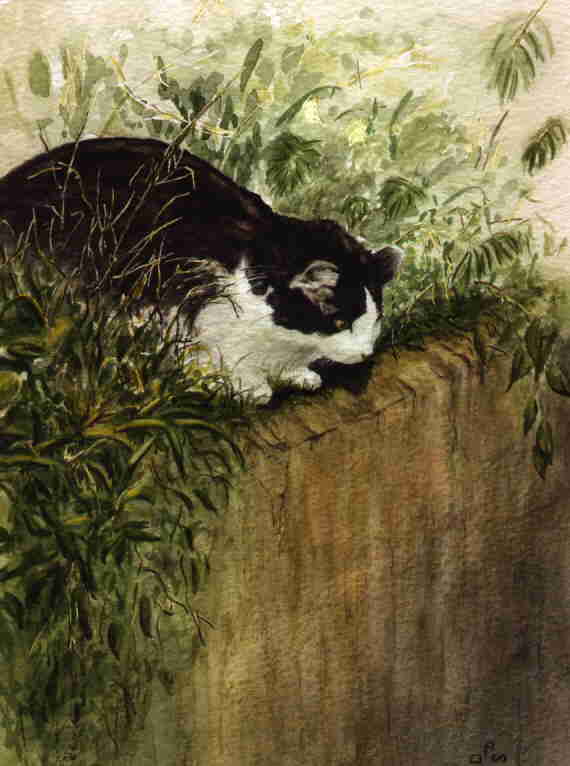
Hodge likes birdwatching
Watercolour, painted by David Simon
Click on the picture to see me better

Is your playful feline playing up?
Solving common feline behavioural problems
source: Guardian supplement, Pets: cats and dogs, March 2010, p21
Cats' behavioural problems include scratching furniture. When cats scratch in just one or two locations, they may need a scratching post to keep their claws in trim. Catnip sprayed on the post can persuade the cat to use it as an alternative to furniture. Cats may also scratch to mark, especially if they are stressed. Enzyme cleansers help mask the odour, and keeping cats' food and litter trays away from other cats can remove sources of stress. Litter trays should be clean, provide enough room, and in quiet locations, and be away from feeding and resting areas. Two or more cats need two or more trays. Feline houstraining problems often arise from inadequate litter trays.
Cats are naturally playful, and providing toys like puzzle feeders and fishing rods helps calm them if they are too enegetic. When humans share feeding and play time, cats are less likely to depend on a single person. Cats may also benefit from daily play sessions to channel their energy.
CA,BT
 Top
of page Top
of page
Does your cat know its name?
Training and naming cats
source: Perri Lewis
Guardian supplement, Pets: cats and dogs, March 2010, p29
Cats learn to come to their owners when called by name because they are usually rewarded for doing so. Cats can also be trained to mew or sit on command by rewarding them for it. Owners usually train cats to respond to their names without thinking about it. Shorter names, like Socks or Sam, are better than longer names, because cats can more easily recognise shorter names.
CA,BT
Top
of page
First Impressions
Bringing a new cat into the home
Source: Sarah Whitehead
Feline Advisory Bureau Volume 39 (2) 2001 p 43
Cat owners often overlook the fact that cats need time to accept a new individual into the home, be it another cat, dog or human. Most cats will view a feline newcomer as an ‘intruder’ in their territory so it is important to take things slowly with no visual contact initially so that each cat can become accustomed to the scent signals of the other. Scents can then be exchanged by petting one cat and then the other, so that there is a collective ‘group’ smell. The new cat can then be placed in a large pen in the same room as the existing cat so that there is visual contact without risking physical conflict. Once the cats are more relaxed in each other’s presence they can be fed in the same room, with the new cat still in the pen, gradually moving the food bowls closer, until progression to first meetings without the pen. It’s important to remember however that with some cats, personality differences may never be overcome.
CA,BT
Top
of page
Homeopathy and Cats
Homeopathy for cats with emotional problems
source: Alison Hudd
Feline Advisory Bureau Volume 39 (2) 2001
starts page 56, 2 pages long
Bach Flower Remedies were developed for humans, but are also be safe, gentle and effective for cats. Each remedy is for a specific emotional mood and remedies can be mixed together to treat a combination of moods and emotions. Rescue Remedy is a combination of five remedies and can be used in emergency situations, such as the death of a companion or family member. Subsequent remedies can be chosen according the cats reaction to grief, which can manifest itself in several ways, such as not eating, becoming aggressive or clingy and losing interest in life. The appropriate remedies are made up into a treatment bottle and given frequently directly onto the tongue, or applied to earflaps, pads or nose. Two case studies of the use of flower remedies in cats suffering from grief are provided.
CA,HD
Top
of page
Postmen put boycott on house where 'Danger Puss' lies in wait
for them
Postmen refuse to deliver to house with dangerous cat
source: Martin Wainwright Guardian June 28 2003 p5
Postmen are refusing to deliver mail to a house in New Milton, Hampshire,
England, because a tom cat called Purrdey has been attacking them. The cat
has spat at postmen, and jumped up at their throats where it digs its claws
in. It has been leashed, but will still attack while on the leash. The cat's
owner is a 79-year-old councillor, who receives a lot of mail, which he now
has to collect himself.
CA,BT
Top
of page
Behavioural problems in cats and dogs
APBC review of cat and dog behavioural problems referred
in 2001
source: Veterinary Record vol 151 no 9, August 31 2002 p252
The Association of Pet Behavioural Counsellors (APBC) has issued a review
of feline and canine cases seen in 2001.
Indoor marking, mainly spraying, was the most common problem found with cats,
accounting for 25.5% of cases. Housetraining problems and aggression towards
people or other cats were also common cat problems. There was little difference
in numbers of male and female cats seen. The domestic shorthair was most common
cat breed seen, though this could be because it is the most common breed kept
in the UK.
Aggression shown towards humans accounted for 36% of cases of more than 1,000
dogs seen, with dog-dog aggression accounting for 19% and phobic and separation-related
problems each accounting for 9% of the total. Males were seen more often than
females. The breeds most commonly seen were crossbreeds, border collies and
German shepherds, though this could simply be because of these breeds are
common in the dog population of the UK as a whole.
CA,BT
Top
of page
Teaching old dogs new tricks
Preparing cats and dogs for the arrival of a new baby
source: Beverley Cuddy
Guardian Weekend May 12 2001 p73
Dogs and cats can live harmoniously with new babies, so long as owners use
common sense and supervise them properly. However, parents are often under
pressure to give up their pets. The National Canine Defence League has discovered
that concerns relating to children and babies account for 15% of cases of
dogs being given up to their centres.
Dogs need to learn that there are new restrictions on where they can go in
the house, and they should be taught this before the arrival of the baby.
This means that the baby’s arrival is not linked to a loss of privileges.
Carrying round soft toys can help get dogs used to babies being carried around.
Owners should remove dog toys that appear similar to children’s toys.
Mothers-to-be can also invite friends round with babies, to accustom dogs
to the way babies smell and sound, and they can allow a dog to smell clothing
from a hospital-born baby, prior to that baby coming home.
Cats can be taught about babies in similar ways, and need teaching that they
should not go inside pushchairs and cots. Cats may show signs of stress when
babies arrive, and may urinate in the house. Owners need to reduce the time
spent with both cats and dogs before babies arive, since otherwise jealousy
is more likely to occur when owners have to spend time on their babies, and
can’t spoil their pets as much. Neither dogs, nor cats should be left
unsupervised with babies.
CA,BT
Top
of page
Evidence for an association between pet behaviour and
owner attachment levels
Links between the behaviour of cats and dogs and levels
of attachment shown by their owners
source: James A. Serpell
Applied Animal Behaviour Science vol 47 no 1-2, April 1996
starts p49, 12 pages long
Behavioural problems are a common reason for people giving up pets to animals
shelters, but there has been little research into links between pets’
behavior and levels of owner attachment. Studies on attachment have tended
to focus on companionship as a benefit, or other areas which are not linked
to the animal’s behaviour. This survey, of 47 cat owners and 37 dog owners,
has investigated links between owner attachment levels and animal behaviour,
asking questions of owners a year after they had taken home cats or dogs from
two UK animal shelters.
The survey involved a postal questionnaire asking about the pets’ behaviour,
views of actual and ideal pets, and levels of attachment to their pets. No
owner described themselves as not particularly attached, all choosing either
moderately attached (19 owners) or very attached (65 owners).
Owners of cats and dogs did not differ in terms of attachment, but dogs were
seen as different in terms of behaviour, eg more playful, affectionate, active,
and confident when faced with unfamiliar situations than cats.
Actual dogs were measured against an ideal, and were found to be less confident,
less obedient, and not as happy about being left alone, and more affectionate,
excitable and active than ideal dogs. Actual cats were seen as less confident,
affectionate, playful, obedient, and intelligent than ideal cats, and more
excitable and aggressive towards their owners and others they knew.
The ‘ideal’ ratings of cats and dogs was not significantly different
between very attached and moderately attached owners. Very attached owners,
however, saw dogs as more intelligent, and cats as noisier than moderately
attached owners. While moderately attached owners of dogs seemed generally
less satisfied with their behaviour of their dogs, moderately attached cat
owners seemed more satisfied with some aspects of their cats’ behaviour,
such as how energetic they were, compared to their ideals.
The length of time someone owns a pet, and where the pet comes from can affect
attachment levels, and these variables were controlled for in this study.
Cat owners rated their cats as less intelligent than dogs. They were also
not seen as significantly cleaner, quieter or more able to tolerate being
left alone than dogs, though this may be linked to their having come from
a shelter. Dogs tended to diverge from the ideal in terms of needing more
affection and being worried about being alone - which may also be linked to
their coming from a shelter. Aggression was not seen as a problem with dogs,
which may be because shelters are wary of rehoming dogs showing signs of aggression.
Owner-directed aggression is not common in cats, and again the prevalence
of this problem in the sample could be linked to cats having been given up
to shelters because of such aggression.
There was no link between ideal views of cats and dogs and levels of attachment,
so lack of attachment does not appear to be linked to unrealistic expectations.
‘Actual’ ratings for most behaviour also did not appear to be linked
to attachment levels, though noisier cats and more intelligent dogs seemed
to have owners that were more attached. Absolute levels of behaviour may not
be important for owners. However, average discrepancies between ’ideal’
and ‘actual’ ratings was linked to attachment levels, especially
for dogs. This may be because dogs’ behaviour has more of an effect on
owners, due to dogs being bigger and interacting more with owners.
More research is needed, since the numbers of moderately attached owners
were small, but there does appear to be a link between the behaviour of pets
and how attached their owners are, especially where dogs are concerned. This
is worth looking into, since more attached owners are more likely to keep
rather than abandon their pets.
CA,BT
Top
of page
Patterns of cat behavior at feeding occasions
Cat-human relations when cats are fed
Source: John S. Bradshaw and Sarah E. Cook
Applied Animal Behaviour Science
vol 47 no 1-2, April 1996
starts p61, 14 pages long
There are different ways of studying relationships between cats and humans,
and one way is to focus on interactive behaviour in terms of sequences and
motor patterns. Feeding is not the only way in which cats bond with humans,
but it is important, since cats do not usually develop attachments to households
unless they are fed there. It is also worth studying, because it occurs regularly
and is easy to observe.
This study involved 36 cats from Southampton, UK, all of which were spayed
or castrated, apart from one tom. Nervous cats that did not trust strangers
observing them were excluded, as were cats only appearing for food on an irregular
basis. The cats’ behaviour was recorded from when food was offered until
they went out of the house, or five minutes after finishing their meals, whichever
happened first.
Some behaviour did not involve the cats trying to communicate with humans
feeding them, and this included grooming, lip licking, and looking around.
Other behaviour did involve communication, and included following, looking
at and rubbing the owner. A third set of behaviour, such as flicking the tail
and miaowing, is important for cats communicating with other cats, though
this type of behaviour was observed without any other cats being there.
The most common behaviour before a meal consisted of the cats interacting
with the owner and using cat-cat communication signs. Cats were less likely
to interact with owners after feeding, and tended to groom themselves.
Cats also tend to have their own behavioural styles. The way that these cats
behaved after feeding did not appear to be linked to their behaviour prior
to their meal. Younger cats were more likely to go out of doors following
their meal, but otherwise there appeared no link between cats’ behaviour
and other factors such as age, sex, the cat’s origin, and whether other
pets were in the household. Owner characteristics also appeared to have little
effect on the cats’ behaviour when feeding, though owner attitudes will
probably affect how cats respond to grooming and playing, ie activities where
owners are more directly involved. Inherited tendencies and developmental
factors may therefore explain behavioural differences between cats at feeding
time.
CA,BT
Top
of page
Eau de fat cat
Patent for mix to persuade cats not to spray in the home
source: Barry Fox
New Scientist September 23 2000 p7
Dynavet, from France, has gained a patent for a fatty acid mix that aims to curb the marking of territory in the home by cats. The cat is drawn to rub a cheek against an object where the mix has been wiped, rather than the cat spraying the object, or location, with urine. The mix includes aminovaleric and caproic acids, and can be produced as a stick, paste or spray. The patent number is GB 2 345 635.
CA,BT
Top of page
Stop pussyfooting around on my keyboard
Package to deal with cats walking on computer keyboards
source: Paul Marks
New Scientist December 4 1999 p18
BitBoost Systems has developed a package that is able to detect when a cat is walking on the keyboard. The PawSense package also makes the computer emit a noise intended to make the cat go away. The software is geared to recognising taht a cat is using the keyboard within a paw step or two. Games can be programmed into the product so that it recognises them. Lisa Lidderdale, who edits the periodical Cat World, believes that some cats might find the noise that PawSense makes attractive. Some cats will walk on piano keyboards.
CA,BT
Top of page
Toy Story
Toys for kittens and cats
source: John Bradshaw
Your Cat August 1999
starts p38, 2 pages long
When kittens start playing it is usually with their littermates or their mother, and they may see toys as rather frightening at this stage. However by six or seven weeks old kittens will play with toys as a way of practising for hunting. The best toys for kittens to play with therefore are those that resemble the type of prey cats like to hunt in the wild, mouse size or smaller. Older cats will also play with toys, but their boredom threshold is quite low so a selection should be offered on a rotation basis. Also toys with unpredictable movements will be more attractive and hold their interest for longer, and this is an opportunity for owners to be involved.
CA,BT
Top of page
Can cats be trained?
Training cats
source: Sarah Heath
Your Cat January 2000
starts p32, 3 pages long
Most people would think that a cat could not be trained to perform tasks on command, but to some extent we do try to control our cats, by calling them in at night and stopping them walking on kitchen work tops. Training a cat requires an understanding of its motivation, and certainly reward-based training is appropriate and can increase the chances of success. The rewards would depend on the individual cat, but food and play are inherently rewarding. Teaching a cat that something is unacceptable requires a deterrent that the cat will not associate with you, and a reward when the unacceptable actions are stopped.
CA,BT
Top of page
Claws out for the man who dreams of shooting cats
British TV naturalist calls for curfew for cats to protect wildlife
source: Myranda Mowafi
Daily Mail February 6 p25
British TV naturalist, Chris Packham, argues that cats should be licensed, subjected to a curfew, and made to wear bells, in order to protect wildlife. He shoots cats using a water pistol, and favours a scheme used in Australia where wardens are allowed to shoot cats breaking a curfew. He also wants more cats to be neutered. His comments follow claims from the Mammal Society that cats kill some 275 million creatures annually. Judy Bernstein, from Cats Protection, argues that cats should not be shot at with water pistols. Cats Protection has spent 3.5 million pounds sterling on a scheme to neuter cats. The RSPCA is also concerned about Packham's statements, due to the large number of animal cruelty cases seen by the RSPCA.
CA,BT
Top of page
How to foil the cuddly killer
Measures to curb killing of wildlife by cats
source: Penny Wark
Times February 1 2001
starts p8, 2 pages long
The Mammal Society has estimated that British cats kill 275 mllion animals annually, representing an average 30 killed per cat. Bells are not a deterrent, but confining cats indoors at dawn and dusk does reduce their kill rate. This is because cats tend to hunt at these times, argues vet, Roger Mugford. Birds tend to be safer from cats when they are older, though rodents tend not to learn to avoid cats. The RSPB offers advice to cat owners who also want to protect birds. Birds are most vulnerable when they are nesting, and benefit from cover offered by hedges, and plants with berries, Nest boxes should be located by prickly bushes, and birds should be fed on tables located away from possible cat launch pads, like walls and trees. Cats can also be fitted with a device called 'The Liberator' from Highcraft, which warns birds by flashing and beeping when cats jump up, but does not warn mice since cats move down to catch mice.
CA,BT
Top of page
What makes your cat a killing machine
Factors affecting cats' ability to catch prey
source: James Allcock
Times February 1 2001 p9
All cats have an inbuilt desire and ability to stalk and catch prey. Some
breeds are better hunters than others. Somalis, Burmese and Siamese cats like
to be outdoors so have more time available hunting. Russian Blues prefer to
be indoors. Breeds with long faces are better able to grasp prey, while flat-faced
breeds like Persians cannot hold prey as easily. Most British cats are not
pedigrees and their ability to hunt is linked to the way their mother brought
them up. Feral cats hunt, but hungry cats do not hunt better than well-fed
cats, since patience is needed for hunting, and well-fed cats are better able
to be patient. Cats do not hunt any less if they are neutered, and can focus
on hunting more if they are not distracted by sex.
CA,BT
Top
of page
Home alone
Home alone cats
source: Your Cat April 2000
starts p4, 3 pages long
Animal behaviourists are seeing more and more problems in cats that are left at home alone, particularly amongst the foreign breeds, such as Bengal and Burmese. Such problems can be resolved by first looking at environment enrichment so that cats are able to express their natural behavior. This can be as simple as hiding dry food in various place around the home, so that the cat uses its natural foraging behavior. There are also feeding devices that encourage the cat to paw the food out. Access to outdoors is not always the answer to boredom, as this can cause problems due the territorial nature of the cat.
CA,BT
Top of page
Kitten time
Guide to choosing and owning a kitten
source: Your Cat April 2000
starts p18, 3 pages long
It is important to prepare the house and garden in advance before acquiring a kitten, as kittens will explore anything and everything. It is to be hoped that your kitten will have had plenty of early experiences to help him to become well balanced, such as meeting new people, including children, and living amongst the general hustle and bustle of a household. It may be wise to adopt two kittens if your are concerned about one kitten being alone for any amount of time, and certainly, play with littermates enhances the kittens' competitive and social abilities. Very young children should not be given sole responsibility for the new kitten, and toddlers should be supervised, but older children should be encouraged to be involved in the kitten's upbringing.
CA,BT
Top
of page
See also:
Cat
health: Vaccination, infections and epidemiological studies
Cat
health: Digestive problems, kidney disease and poisoning
Cat
health: Other health issues
Cats:
Effect on Human Health
Cats:
Behaviour and training
Cats: General
articles
Reviews
of Cat books, including books on health and behaviour
Books on Animal Behaviour including Animal Coginition
|