Dogs: Books on skills training: Agility and training games
If you want to buy a book, clicking on the book
cover will take you directly to that book on the Amazon.co.uk web site.
See also:
 Dogs:
General Dogs:
General
Dogs:
Health and Nutrition
Dogs:
Books on single breeds
Dogs:
Origins, canine evolution and wolves
Dogs: Puppy and manners training
Dogs: Behaviour and training philosophies
Dogs:
Breeding and kennel management
Dogs: Fiction
and biography relating to dogs |
 |
|
|
|
|
|
Click on the cover above
to go to this book
at Amazon.co.uk
|

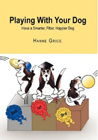
Playing With Your Dog [Paperback]
Hanne Grice
Xlibris Corporation (5 Oct 2010)
ISBN-10: 1453529640
ISBN-13: 978-1453529645
As this books claims, games help make dogs smarter, and keep them fit and happy. Playing games with dogs also makes them easier to understand and manage. This book has a lot of good ideas for games for dogs of varying levels of fitness, and you don't need to use special equipment to play them. There is an explanation of dog behaviour, and a stress on safety. The book is easy to follow, and is a good introductory guide to the world of human-dog games. It would suit both dog owners, and dog clubs.
 Top
of page Top
of page
|
Click on the cover above
to go to this book
at Amazon.co.uk
|
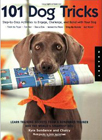
101 Dog Tricks: Step-by-step Activities to Engage, Challenge, and Bond with Your Dog
Kyra Sundance Rockport Publishers Inc. (1 April 2007)
ISBN-10: 1592533256
ISBN-13: 978-1592533251
This book is especially useful for people with young, active dogs who want to channel and direct their energy. Yes, you can impress people with the 'tricks', but there is a lot of training involved too, and this makes it much easier to control your dog. The book is well structured, so you can go from easy to difficult tricks, and it's well illustrated, so it´s easy to follow. It's a good book if you have kids, because they will enjoy teaching the dog on their own, will learn about training in an enjoyable way, and there are activities you can do together as a family. Highly recommended.
Top
of page
|
Click on the cover above
to go to this book
at Amazon.co.uk
|
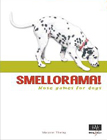
Smellorama! - Nose games for your dog
Viviane Theby
Veloce Publishing Ltd; 1 edition (15 April 2010)
ISBN-10: 9781845842932
ISBN-13: 978-1845842932
ASIN: 1845842936
Smellorama! is a book that makes scent work accessible for most owners. It´s easy to follow, and well-illustrated. There are other more specialist books on scent work, this book on 'nose games' is geared to owners who are just starting out, and who are trying out the activities for fun. Even so, it´s pretty good for a pet owner´s guide, and has games with different levels of difficulty. Your dog may well learn some very useful skills, and surprise you by how much he can do. There´s a lot in this book that helps to understand dogs better, for example, how their noses work, and how they try to give us information. This is a book that most pet dog owners will enjoy using, because all dogs love to use their noses.
Top
of page
|
Click on the cover above
to go to this book
at Amazon.co.uk
|
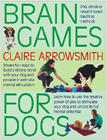
Brain Games For Dogs
Claire Arrowsmith
Interpet Publishing (30 Jun 2010)
ISBN-10: 1842862774
ISBN-13: 978-1842862773
Brain Games For Dogs is great fun, with a lot of ideas for games with varying levels of difficulty. It's well illustrated and well written, so is easy to follow. The author, Claire Arrowsmith, is very experienced in working out what dogs are capable of, both mischief and achievements. She has worked with problem dogs, rescue dogs, dogs for deaf people, and provides advice in Your Dog. This is a book which your dog will enjoy sharing with you. He doesn´t have to be a super obedient border collie to play these games, in fact the dogs that benefit most from this book are perhaps those more independent dogs who ask 'what´s in it for me?' when you want them to do something. What´s in it for them? Well fun, they do what you ask, and get to enjoy themselves more.
Top
of page
|
Click on the cover above
to go to this book
at Amazon.co.uk
|
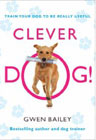
Clever Dog
Gwen Bailey
Collins (28 May 2009)
ISBN-10: 0007279930
ISBN-13: 978-0007279937
Some people might describe this book as a guide to teaching dogs tricks, but it is far more than this, it can also help you to teach your dog useful jobs, and give him or her some intellectual stimulation. Giving dogs something interesting to do makes them happier, calmer, and helps to improve communication between dogs and owners. They have to pay attention to you in order to get what they want. It's far better to stretch dogs' minds than play mindless ball games in the hope that this will tire them out! My only complaint is that this book is too short, I want more. For serious skills training, working dog books provide more depth, especially those dealing with tracking and retrieving. However, this book is relatively inexpensive, and is highly recommended as a starter book to help owners learn to teach complex skills to their dogs.
Top
of page
|
Click on the cover above
to go to this book
at Amazon.co.uk
|
Clicker Training For Obedience
Morgan Spector
Sunshine Books
ISBN 0962401781
This is an excellent introductory guide to clicker training, with very
clear instructions. Clicker training is a reward-based method for training
dogs, which relies on 'clicks' to communicate with the dog. It is a technique
that is based on operant conditioning theories, and it can give rapid
results - either because dogs understand it easily, or because it forces
owners to think about what messages they are sending their dogs! Karen
Pryor is another fan of operant conditioning, and her 'Don't Shoot the
Dog' is perhaps more useful for people with more experience, because she
deals with behavioural issues in greater depth, and helps owners to choose
solutions that best suit them. However, if you want a clear-cut, 'how
to' book, this is the one for you.
Top
of page
|
Click on the cover above
to go to this book
at Amazon.co.uk
|
The Beginner's Guide to Dog Agility [Paperback]
Laurie Leach
Publisher: TFH Publications (USA); 1st edition (1 Sep 2006)
ISBN-10: 9780793805464
ISBN-13: 978-0793805464
ASIN: 0793805465
This is what it says, a book for beginners who are interested in Dog Agility. It's clearly written and very well-illustrated. There´s an account on the history of the sport, and practical advice on setting up a course. Strengths: it is very clear, and would be an ideal present for older children. Weaknesses: if you are really into agility, you will want a more in-depth book. It´s also written for Americans, and some people may want to know more about the sport in the UK. This book is good value if you just want an introduction, or are trying to persuade a friend or a child to take up the sport.
Top
of page
|
Click on the cover above
to go to this book
at Amazon.co.uk
|
Agility
Patrick Holden and John Gilbert
Ringpress
ISBN: 1860540449
This is an excellent guide to agility, which is very useful for people
new to this activity, because it is far easier to make sense of commands
taught in agility training if you also have a written and illustrated
overview. It is also a useful resource for experienced owners, because
of the quality of the detailed explanations. The book is certainly a must
have for any agility club, so that it can be lent to members to read at
home.
The focus in the book is on competitive agility, though the authors stress
that it should be fun. Agility is a very good way for owners and dogs
to get to know each other, and for both to have physical and mental exercise
in an enjoyable way. It is such a useful activity that it would be helpful
for non-competing owners to have a little more advice than is given in
this guide. Border collies tend to dominate agility in the UK. Non collie
owners often feel they have little chance of competing with the collies’
intensity, dedication and speed, and may well feel out of place in a club
dominated by collies. Agility, in the sense of obstacle courses that dogs
follow on the direction of their owners, is so useful and enjoyable that
there is a case for expanding the sport, and designing courses for different
breeds. Long-legged dogs, for example, may find the height of the A-ramp
difficult to deal with, so an adjustable version of the A-ramp could be
useful.
This book also focuses on participants in agility, rather than on people
wanting to set agility clubs, or just wanting modified courses in their
back yards. One of the big problems that owners often have is transport
to agility classes. Attending often involves travelling some distance
because agility classes are not as easy to find as obedience classes.
More information for people setting up courses would be helpful.
‘Agility’ is an excellent resource for dog owners, and it is
precisely because this book is so good that it would be a pleasure to
have more from these authors, who perhaps will one day delight us with
a longer version.
Top
of page
|
Click on the cover above
to go to this book
at Amazon.co.uk
|
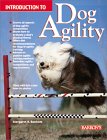
Introduction to Dog Agility
Margaret Bonham
Barron's Educational Series Inc.,U.S.; 2nd Revised edition edition (1 Jun 2009)
ISBN-10: 0764141384
ISBN-13: 978-0764141386
Dog agility can be very enjoyable for both owners and dogs, and can help us learn how to communicate with our dogs, as well as helping to channel the energy of ‘hyper’ dogs into something constructive. So what if the collies tend to dominate agility classes and competitions, you can still do agility for fun, and Margaret Bonham shows you how. She covers all levels of agility activities, from setting up a course in your garden or a field, to competition events (for you collie owners…). This book is an excellent introduction for beginners, since it is clearly written, and is comprehensive enough to be of interest to owners with experience of agility, and to trainers.
Top
of page
|
Click on the cover above
to go to this book
at Amazon.co.uk
|
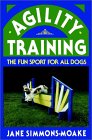
Agility Training: The Fun Sport for All Dogs
Jane Simmons-Moake
Howell Bk.Ho.
ISBN: 0876054025
This book is a very useful reference book for people starting an agility
club, or who want to try out agility with friends. There are clear instructions
on how to 'do agility', as well as help with building your own course.
The focus is also on enjoying the sport, rather than taking it in deadly
earnest. Agility is such a useful way of training dogs, and learning to
communicate with them by having fun, that it's refreshing to read a book
that looks at the sport in terms of enjoyment.
Top
of page
|
| |
|
| |
|
| |
|
| |
|
| |
|
| |
|
| |
|
| |
|
|
|
|


