Dogs: Books on training
If you want to buy a book, clicking on the book
cover will take you directly to that book on the Amazon.co.uk web site.
See also:
 Dogs:
General Dogs:
General
Dogs:
Health and Nutrition
Dogs:
Books on single breeds
Dogs:
Origins, canine evolution and wolves
Dogs: Skills training: Agility and training games
 Dogs: Skills training:Sheepdog, gundog and scent work Dogs: Skills training:Sheepdog, gundog and scent work
Dogs: Behaviour and training philosophies
Dogs:
Breeding and kennel management
Dogs: Fiction
and biography relating to dogs |
 |
|
|
|
|
|
| |
|
Click on the cover above
to go to this book
at Amazon.co.uk
|

Good Dog: The easy way to train your dog
Sarah Whitehead
Collins and Brown 2011
ISBN-10: 1843406284
ISBN-13: 978-1843406280
Good Dog tells us in Chapter One that training should be fun. We can plan classes, and use our brains, to make training enjoyable for ourselves and our dogs, rather than trying 'bullish tactics'. Most owners would agree with this, a bit of thought helps with raising dogs, as it does with raising kids. There are more effective ways of raising both than bellowing at them and hitting them as the first option. Most of us have figured this out, and would agree with Sarah Whitehad. She also advises us to fit training into daily routines, like during the advertisement breaks for TV programmes. It's true that if you have a lot of commitments, time management is important, as most owners and parents would agree.
Where Good Dog comes to life, however, is in Chapter 5, which takes owners beyond basic manners training, towards teaching skills, for example moving from games of fetch to formal retrieves, or teaching scent work. Chapter 6, the last chapter deals with harnessing inbuilt desires to teach the dog acceptable activities such as agility. As a book for pet dog owners, Good Dog is quite helpful, given that many training books are unadventurous and stick to basic manners training. Dedicated owners can pick out ideas for teaching a wide range of skills to their dogs, using this book as a guide. This is likely to improve relationships between owners and their dogs, because the more we do interesting activities with our dogs, the better we understand each other.
Read More
 Top
of page Top
of page
|
Click on the cover above
to go to this book
at Amazon.co.uk
|
My Dog Pulls What Do I do
Turid Rugaas
Dogwise Publishing (1 July 2005)
ISBN-10: 1929242239
ISBN-13: 978-1929242238
This is a very useful book on a very important topic. Walking on a slack leash is an essential skill for a dog, and it makes it easier for owners to control the dog in the faceof distractions, like heavy lorries. This method works for most owners. It is not an instant cure, but you should see a quick improvement, and there is no need for special equipment. There is no guarantee that it will work for you, but it´s worth giving it a try.
Top
of page
|
Click on the cover above
to go to this book
at Amazon.co.uk
|
Barking: The Sound of a Language (Dogwise Training Manual) [Paperback]
Turid Rugaas
First Stone (24 Jan 2009)
ISBN-10: 1929242514
ISBN-13: 978-1929242511
This book looks at barking from the point of view of the dog, so helps owners understand why dogs bark, a step towards controlling the barking. There is help in tackling the problem of an extremely talkative dog, but as Turid Rugaas points out, sometimes our dogs are trying to tell us something with their barks, and it is worth listening. Very highly recommended.
Top
of page
|
Click on the cover above
to go to this book
at Amazon.co.uk
|
How to Train a Superdog
Gwen Bailey
Dorling Kindersley (1 May 2009)
ISBN-10: 1405332344
ISBN-13: 978-1405332347
A very good first general dog book for people who want practical advice rather than lots of pretty pictures. The book does deal with training, as the title implies, but also provides help right from the moment when you decide you want a dog. There is help with choosing a breed, developing exercise schedules, teaching basic obedience, and more complex skills. The illustrations make it easy to follow the instructions. It is refreshing to read books which focus on what dogs can do, as well as how to prevent them doing things we'd rather they didn't do. Yes, it is true that manners training is the solid bedrock, but training can go much further than this, to the benefit of both dogs and owners. This is one of a newer crop of canine guides which draws on recent research to help owners develop dogs' potential. A highly recommended starter book for anyone taking on a dog.
Top
of page
|
Click on the cover above
to go to this book
at Amazon.co.uk
|
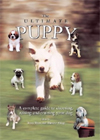
The Ultimate Puppy
Ed. Terry Ryan and Theresa Shipp
Ringpress Books
ISBN: 1860541739
Terry Ryan has been an obedience instructor since 1968 and has held seminars
and lectures all around the world while Theresa Shipp has 8 years experience
training, having run her own dog school for the past 5 (at the time of
publishing), specialising in puppies and gundogs. She is also a member
of the Association of Pet Dog Trainers (APBT), which was founded by the
late John Fisher and is the only recognised dog trainers' organisation
whereby members must abide by a strict code of conduct and have gained
academic and practical qualifications. To
learn more about the APDT click here.
In addition to their own input, the editors also draw on the experience
and specialist skills of five experts from varying backgrounds within
the dog world, including training, veterinary medicine, dog psychology,
grooming and breed experts.
From the visual aspect, this book is all but irresistible! It is sheer
indulgence for all dog lovers, lavishly illustrated with so many beautiful
photographs that they actually distracted from the text; from the textual
content aspect, I found this book very easy to read, so long as I could
stop myself flicking back to look at my favourite pictures!
In all honesty, from cover to cover, I absolutely loved this book. Of
all the puppy books I have read, this one has been the one that covers
the most ground in not only the greatest detail but I also especially
loved the little extras, for example in the chapter 'The Perfect Companion',
not only does this book mention some of the things you can do with your
dog should you have classes available locally, but it also shows you and
gives you basic instructions on how to get started yourself at home.
My one criticism might be in that they could have provided a little more
in the way of where to obtain further information for those who are in
the research stage of buying a puppy, the people at whom this book is
aimed. As an example, a good selection of basic breed profiles are covered
but they would not be enough to help someone really understand the breed
specific character of each. A web site addresses, where applicable, to
breed clubs and forums, or at very least telephone numbers of the breed
secretaries would help the reader to gain quick and easy access to the
information that they would need to meet owners and breeders before making
their final choice. At the same time, I appreciate that this book is aimed
at an international market and that web sites and telephone numbers may
change over the course of a few years. For a selection of breed specific
web sites and forums, click
here.
If you were in any way considering buying a loved one a puppy for Christmas,
please don't. Buy this book instead, so that if your loved one really
wants a pup, they can learn what to expect, about the joys and responsibilities
involved, and the puppy will have the best start in life.
Review by Diana Attwood.
Top
of page
|
Click on the cover above
to go to this book
at Amazon.co.uk
|
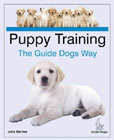
Puppy Training the Guide Dogs Way
Julia Barnes
Ringpress Books
ISBN 1860542093
Guide Dogs for the Blind have been rearing and training puppies for
the most demanding responsibilities that we ask of any dog, keeping careful
records of each dog and its progress, over the course many years. In doing
so, they have created a puppy training programme by which all their dogs
are reared to ensure the highest success rates.
Beautifully illustrated with lots of puppy photos and interspersed with
case studies to highlight specific points, this book takes you through
every stage of puppyhood, from understanding the importance of choosing
a puppy from health-screened and well-natured parents; puppy-proofing
your home; socialisation with other animals and getting pups used to different
environments; basic ‘good manners’ training; the dreaded adolescence,
and sports and activities you can do with your dog.
Although the book lightly covers breed specific differences in behaviour
and character, dogs chosen for guide dog work are naturally biddable,
and the guide dog training programme has been designed around particularly
biddable dogs. For breeds of more independent and wilful character, a
little more depth into finding and building on your dogs motivation would
help the reader whose puppy is just as happy to carry on sniffing around
the room as take any notice of his owner.
The training methods in this book are all motivation and reward based
and although the much over-used ‘dominance’ word crops up with
regard to the adolescent dog, it is nice to read a modern training book
that doesn’t suggest your puppy will want to rule the world. An added
plus for this book is that all royalties from its sale are donated directly
to Guide Dogs for the Blind.
Review by Diana Attwood.
Top of page |
Click on the cover above
to go to this book
at Amazon.co.uk
|

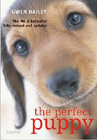
The Perfect Puppy (Revised Edition)
Gwen Bailey
Hamlyn
ISBN-10: 060061722X
ISBN-13: 978-0600617228
This is a revised edition of Gwen Bailey's best-seller, which is deservedly popular because of its clarity. It is very easy to follow, which is important if you feel a little frazzled, with few functioning brain cells, on account of the exploits of your pup. If you have to choose just one pup book, this is probably the best of the bunch.
Sometimes, it's true, Gwen Bailey seems to forget that owners may have non-dog lives, and cannot devote 24 hours out of 24 to their pups, however much they adore them. She is perhaps a little over-optimistic on how often owners can reasonably be expected to take their pups out for a wee, for example. The general principles are important though, and in this case, obviously the more a pup goes outside when he is likely to need to perform, the quicker he will learn to perform outside. You can also pick out the tips, such as staying with your pup when you take him out to wee, and praising your pup when he has performed.
The most useful time to start using this book is, of course, when your dog is still a pup, but you can also use it as a source of ideas for remedial education, both for dogs you have had since puppyhood, and any dog you may take on as an adult. True,.sometimes the tone is a bit hectoring. You may feel that you are a complete failure because your dog is long past puppyhood and is still not perfectly obedient. Don't be put off, just persevere, keep a training diary, and look back on the progress you have made, rather than trying to measure yourself against perfection.
On balance, this book is highly recommended, both as a puppy book, and as a very useful book for anyone seeking to train a dog, with lots of good ideas.
Top
of page
|
Click on the cover above
to go to this book
at Amazon.co.uk
|
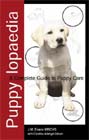
Puppylopaedia
J.M. Evans MRCVS with Caroline Ackroyd-Gibson
Ringpress books
ISBN 1860542395
Puppylopaedia sets out to equip the new puppy owner with the basic understanding
of the way in which dogs learn and how we should harness this in order
to create the 'ideal' dog by the time the puppy has reached one year of
age.
The first chapters go into good depth with regard to appreciating the
personal commitment involved in owning a dog, and the responsibilities
we have towards the community around us before explaining the importance
of choosing a puppy from a good breeder and choosing a healthy puppy.
As you read on, it becomes very clear that the author is a vet! The book
goes into great detail with regards to health care and parasite control
and it also has a very comprehensive glossary, and I particularly liked
the inclusion of the useful contacts and further reading chapter. From
this point of view, I feel that is a very useful book.
As a training book, I'm afraid to say I felt that it was a little old
fashioned with regards to its dealing with dominance and suggestions towards
asserting your dominance over your dog, and its ways of dealing with 'dominant'
dogs. More up to date thinking is that much of the behaviour once perceived
as dominant behaviour, is in fact little more than resource guarding,
which of course is something you want to avoid and discourage. The Association
of Pet Behaviour Counsellors (APBC) has a useful article which explains
changes in views on dominance in more detail: Canine
Dominance Revisited
The book suggests that you should never allow your dog on your bed or
furniture, or even upstairs so that he learns to appreciate his role as
being subservient to that of his family. If he is a 'dominant' dog, there
are some illustrated exercises that show you how to hold his muzzle shut
for a few minutes every day and how to stand over him and lifting his
chest off the ground. By all means it is important to desensitise your
dog to being handled all over from an early age, just as much if he is
of a pushy character or more the shy and submissive type, but I would
really wonder that a dog sees any particular significance in these exercises
other than that his owner is proving himself to be a bit barmy!
Dog like being close to people, and personally I love to snuggle up with
my dog on the sofa and she is allowed to come upstairs and join us on
the bed for the last hour of the morning before we get up - on the strict
condition that she settles quickly and will move or get off if we need
her to, otherwise she is sent straight back to her own bed! It is also
a fact that in this day and age, most people have to go to work and so
dogs are left alone for much longer periods than they were in the past.
Being close to their humans at night goes a long way towards compensating
for this.
It also suggests not allowing your dog to walk through doorways ahead
of you, settle in high places, or lay in your path. Rather than walk over
or round him, you should make him get up if you want to walk past. The
view used to be that dominant dogs try to control you, for example, by
lying in high places. But I know that my dog likes to lie at the top of
the stairs in the landing because that's where she finds a nice breeze
through the house on a hot day, and on a cold day she'll find a cosy corner
or a radiator to stretch out alongside! As for making your dog move every
time you want to walk across the room, if you like to take your dog to
pubs and social gatherings where people are always on the move, it pays
to teach your dog to stay still as people walk past him rather than get
up every time!
By all means being allowed upstairs and on the furniture should be a
privilege, not a right and earning the right entails being polite and
well mannered. Rather than denying the privilege, control the rights and
your dog will be just as well mannered as the next.
Puppylopedia is a useful addition to a dog owner's library, especially
for the veterinary advice it contains, but new owners of pups will need
to supplement it with more up-to-date guidance on training and behaviour.
Review by Diana Attwood.
Top
of page
|
Click on the cover above
to go to this book
at Amazon.co.uk
|
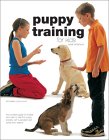
Puppy Training for Kids
Sarah Whitehead
Barron's Educational Series
ISBN: 0764119400
Sarah Whitehead is a UK behaviourist and trainer who has
a particular interest in training puppies. This book is geared to children.
It has a lot of information on dogs, and puppy care, such as feeding and
grooming, as well as instructions on training pups. Young readers from
about age 9-years-old upwards will find it enjoyable to read, while younger
children will enjoy having it read to them. Kids will have fun trying
out the games recommended in the book. They can teach their pups tricks
as well as basic obedience with the help of this book, and teach their
friends. This book is well worth getting for kids when a pup arrives in
the family, since it means they will be able to take some responsibility
for the new arrival, and they could go on to be champion dog handlers.
Top
of page
|
Click on the cover above
to go to this book
at Amazon.co.uk |
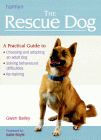
The Rescue Dog
Gwen Bailey
Hamlyn
ISBN 0 600 59691 5
A very useful book for anyone who needs to re-educate an adult dog, not
just people who have taken on a rescue dog. The book is well illustrated,
the tips are easy to follow, and their rationale is well-explained. Anyone
taking on an adult dog will find this book helpful. It's also useful for
people who have raised their dogs from pups, and found them to be a bit
of a handful as they grow up. If you feel you bought 'The Perfect Puppy'
too late, try this book! The story of Beau, a dog with serious behavioural
problems, is told at the end, to show what can be done to re-educate dogs.
This success story is heartening, though novices should be wary of taking
on such dogs. Generally, this book is highly recommended.
Top
of page
|

Click on the cover above
to go to this book
at Amazon.co.uk
|
Living with a Rescue Dog
Julia Barnes on behalf of Dog's Trust
Ringpress Books
ISBN 1860542247
The Dog's Trust, founded in 1891 and formerly known as the National Canine
Defence League, is one of the most well-established and respected rescue
and welfare charities in the UK and re-homes in excess of 9000 dogs per
year.
Recent television programmes have highlighted the plight of the 'rescue'
dog and the sad lives that some of these dogs have suffered, though in
actual fact the majority of dogs that end up in rescue shelters have not
been physically abused, but are simply victims of impulsive purchasing
without careful research, and their owners changes in circumstance.
None-the-less, it is obviously very distressing for a dog to find himself
in shelter kennels, and 'Living with a Rescue Dog' seeks to explain to
people considering re-homing a dog of the importance of researching to
make sure you choose a dog appropriate for your circumstances. The book
also provides a brief guide to breed specific characteristic and talks
about the commitment and responsibilities that new owners will be taking
on, and the special issues that a shelter dog may have.
For example it may well be that the dogs bought by people who had not
properly considered the commitment involved in pet ownership, have missed
out on some vital socialisation so may well be nervous around men, people
in hats etc - not because they have been abused by men or people in hats.
It is much easier to socialise a puppy, but it is certainly quite possible
to socialise an adult dog, you will just have to be a little more patient
and be prepared that it could be a long and gradual process.
I liked the fact that along side information on their own organisation,
they also offered information on the other welfare charities including
independent and breed specific rescue for people looking for a particular
breed of dog, and the sort of requirements and adoption procedures you
could expect from them.
The book goes into good detail on choosing your dog and settling him
in, including introducing him to cats and other existing pets, as well
as friends and family, but I think that they could have mentioned a little
more about how you should be prepared for his character to change a little
as he settles in and finds his feet.
In my own experience, it is often hard to see the dog's true character
as newly adopted shelter dog. Generally, at first he might be very well
behaved because he is a little unsure of the rules in your house, then
as he starts to feel more confident, he might try to push the rules to
see how much he can get away with, and once he realises the boundaries,
will start to show you his true character.
So long as you remain patient and consistent, and you are not tempted
to bend the rules and 'spoil' him by offering him too much extra leniency
out of pity, or in order to make up for his sad past, he'll soon appreciate
his place in your home. You'll be amazed at how quickly your dog seems
to 'forget' all that has happened before and becomes part of your own
family, as if he'd been there forever.
If you are looking to adopt a shelter dog for the first time, particularly
if you have not owned a dog previously or you have not owned a dog of
your own for several years, you will find this book very useful. The socialisation
and training advice this book provides should certainly get you off to
a good start. Once he has settled in, you might want to look at doing
more with your dog, or you might find that he has a particularly challenging
character such as being particularly shy or energetic, so you might want
to supplement this book with some of the specialised training books we
have available.
Review by Diana Attwood.
Top
of page |
Click on the cover above
to go to this book
at Amazon.co.uk
|
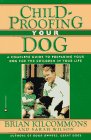
Childproofing Your Dog
Brian Kilcommons and Sarah Wilson
Warner Books
ISBN 0446670162
This is essential reading for anyone combining or intending to combine
children and dogs. Children and dogs love being together, but they need
some help with learning how to get along with each other. Dogs need to
be able to get used to children, and children need to learn what dogs
like and don't like. This book deals with both sides of the equation,
with a helpful chapter on 'Dogproofing your child'. There is also a discussion
of which dog breeds are suitable for families with children. Not everyone
will agree with Kilcommons' recommendations, and it's worth comparing
his views with the recommendations in 'Choosing a Dog for Dummies', reviewed
in our dogs general selection of books.
Top
of page
|
Click on the cover above
to go to this book
at Amazon.co.uk
|
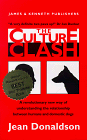
Culture Clash
Jean Donaldson
James and Kenneth
ISBN 1888047054
Jean Donaldson is a lady with strong opinions and a lot of experience
training dogs. She is especially interested in how dogs can be motivated
to learn, which is useful for owners who are interested in reward-based
training. She also has some interesting things to say on why dominance
theory, based on studies of pack behaviour, might be overrated. Some owners
especially those who rate their dogs' intelligence highly will be annoyed
by her views, but she does make many useful points about the ways that
dogs are sometimes misunderstood, such as the need to discard notions
that dogs do things to 'spite' us. She is also very useful on the need
to understand how dogs learn and make it easy for them to learn to be
well behaved. Some people see this book as their 'Bible', others find
Donaldson very irritating. If you prefer a book that covers similar ground
and is a bit more diplomatic, try 'How to Teach a New Dog Old Tricks'
from Ian Dunbar.
Top
of page |
Click on the cover above
to go to this book
at Amazon.co.uk
|
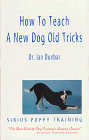
How to Teach a New Dog Old Tricks
Ian Dunbar
James and Kenneth
ISBN 1888047062
This is a very useful book for learning how to train dogs, from young
pups to older dogs who need to learn a few more skills, or unlearn some
tricks that their owners would prefer they didn't do! Ian Dunbar focuses
on how the dog understands what we are trying to get across, and he uses
reward-based methods. He writes clearly, and his work is accessible to
older children, as well as adult owners. He has a 'way' with both people
and dogs, which can get the best out of both.
Top
of page |

Click on the cover above
to go to this book
at Amazon.co.uk
|
Urban Dog: The Ultimate Street Smarts Training Manual
Cis Frankel
Willow Creek Press
ISBN 1572233842
Cis Frankel lives in the US city of Chicago where many of her clients
work long hours and live in high-rise apartments. For many in the UK,
this might sound quite horrifying, but none the less many people and pets
co-exist quite happily under such circumstances, and in this book, Cis
Frankel sets out to explain how to make the best of living with an urban
dog.
To begin with, I found this book extremely hard to get into. I found
that for the first few chapters, every time I put the book down, I would
have to start from the beginning again. I can’t for sure say why,
maybe because this book is so very much geared to an American reader;
or the lack of colour – it is quite a large book for a training book
of its kind, though design-wise it is nicely laid out. Once I was past
that point, it became much easier but it still took me quite a long time
to read.
For training method, Cis Frankel’s method is just a little different
from the ‘run of the mill’ choke chain ‘jerk and praise’
technique. She suggests that when giving a leash correction, that you
should never allow more than four links to slip suggesting to me, that
she uses this more as a sound distraction than as a means of physical
punishment. She also talks a lot about leash control and using her lead
to guide and manipulate your dog into the required walking positions.
Personally, I think that this technique might be easier to follow if demonstrated
than picked up from a book because I found the illustrations quite confusing.
Cis Frankel also explains how you can use the natural obstacles about
the city as training aids – curbstones, parked cars, mailboxes etc.
She also lays a lot of emphasis on respect for other city dwellers and
dog owners, with a great deal of concern for being a responsible dog owner.
This book contains some quite novel and imaginative ideas; although along
side the good ideas there are a few that I would feel a little dubious
about applying. For example I thought that she had some good ideas for
streetwise traffic training, use of mats and throws for dealing with wet
and moulting dogs, and taking advantage of your environment.
More dubious ideas in my mind are that of withholding water at night
while housebreaking (her explanation being that it is impractical to get
a pup down 4 flights of stairs if you are living in a high rise without
a yard), roller blading with your dog, and there is a photograph of her
jumping her dog over a large tin barrel, while the dog is attached to
a lead and on a choke chain, which could be potentially lethal.
As a training book for the UK reader, I do believe it is a very worthy
addition to your bookshelf. Apply your own common sense, but definitely
be inspired.
Review by Diana Attwood.
Top
of page
|
Click on the cover above
to go to this book
at Amazon.co.uk
|
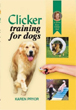
Clicker Training for Dogs
Karen Pryor
Ringpress Books
ISBN 1860542824
Over the past 2 decades there has been a dramatic change in the way we
train dogs. As people have become uncomfortable using the more traditional,
harsher methods of training, many new trainers have made a name for themselves
using kinder reward based methods, but no-one to date has made such an
impact as Karen Pryor, the dolphin trainer from Sea World, who brought
us clicker training.
Clicker training is basically a method of conveying the message to a
dog that he has done something very well and that for his efforts, he
has earned a reward. First you teach the dog that the clicker means reward,
then you teach him to work for the clicker in order to gain his reward.
Basically, it is the same principle that we work on – we go to work
to earn money, and we spend the money on things that we want.
Of course you could just use a treat, but the clicker allows the handler
to be much more precise about which bit of the dogs behaviour was right,
especially where sometimes the dog has to go through several actions to
reach the desired behaviour – such as walking up to, picking up and
carrying a toy. If you are teaching your dog to pick things up, you would
click just as his mouth reached for the object. He then knows that that
was the desired behaviour.
A ‘click word’ like ‘yeah!’ can work well, but sometimes
our voices are inconsistent – it is almost impossible to be 100%
precise with a vocal command whereas the clicker is always consistent
and with a little practice you can be very precise. The dog might hear
the click word in other situations too, which could also lead to desensitising
the dog to it, but the actual click of the clicker is a unique sound,
so the dog will – if you use it correctly - always associate it with
his having carried out the desired behaviour or action.
Two aspects which I find are particularly nice about this method of training,
is that firstly, it encourages your dog to look to you for cues and so
strengthening your relationship with each other. For very nervous or particularly
over confident dogs, gaining their trust and respect can prove to be quite
a challenge, especially when using traditional training methods which
might cause the nervous dog to withdraw into himself and the over confident
dog to just ignore you and wander off, but clicker training quickly encourages
confidence in the nervous dog and respect in the more confident dog, by
developing a bond of trust and a working partnership.
Secondly, it also encourages your dog to use his own mind as he tries
to work out what task or action he can offer that will earn him a click.
As an owner, you will have great fun learning about how your dog’s
mind works and you are sure to a have few giggles along the way while
your dog offers different behaviours. From your dog’s point of view,
this is a very thorough mental work out.
Mental exercise is just as vital to a dog as physical exercise, if not
more so, and can off load off excess energy just as quickly. If ever you
find yourself in a situation whereby your dog is on light exercise only
– maybe you can’t walk your bitch because she is in season or
your dog has an injury, or you just physically cannot take your dog out
for a while - but at the same time he is virtually climbing the walls
for want of exercise, just ten minutes of free shaping with a clicker
will be sure to calm him down. It certainly works for my young Weimaraner,
so I feel qualified to say that it’ll work for just about any dog!
Clicker training for dogs is a very straightforward and clear guide to
get you started. It has a great section giving you simple exercises from
which you can build your skills and gives easy to follow advice on how
you can use your clicker for both practical good manners training and
fun tricks. You cannot help but be inspired. Since reading this book,
I have. Although we had already done some clicker training previously,
in the past 4 days I have dramatically improved up my dog’s loose
lead walking and we have been learning to walk backwards.
The book also suggests that there is a section at the back giving details
of further reading, a feature I am always pleased to see in a book, though
in this case I wonder that this might be a bit of a trick because throughout
it puts emphasis on encouraging both the dog and the handler use their
imagination and think for themselves, but you’ll find that page 111
‘clicker resources’ is completely blank!
Never mind, it’s a great book for anyone who is interested in clicker
training, and even if you are happy with the way your training has progressed
with your dog and feel that you don’t need to train him anymore,
it is also a useful standby should he have to go on restricted exercise.
Its fun for both of you – give it a go!
We have a few sites listed, which you will find useful if you are interested
in clicker training, on our links page. You might also like to read an extended review on Karen Pryor’s ‘Don’t
Shoot the Dog’.
Review by Diana Attwood.
Top
of page
|
Click on the cover above
to go to this book
at Amazon.co.uk
|
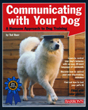
Communicating with your Dog - a humane approach to dog
training
Ted Baer
Barron's Educational Series
ISBN 0764107585
Ted Baer is an American trainer for the motion picture industry, whose
own dog Tundra has appeared in a number of television programmes, adverts
and films including ‘Against All Odds’ in 1984 starring Jeff
bridges, and achieved a PATSY award from the American Humane Association
for her appearance in the popular US series ‘Love Boat’.
Communicating with your Dog was first published in 1989. In the second
edition, being reviewed here, Baer says that he has adopted a more humane
approach to training than in his original edition, and it is recommended
by PETA (People for the ethical treatment of animals).
Baer’s training theory is based around a twenty word programme designed
to help you and your family maintain a consistent set of words when giving
your dog a verbal command, and a set of 15 golden rules. His method is
that of offering a praise reward or punishment ‘correction’
to help your dog understand what the command is supposed to mean. This
second edition also covers toilet training and a chapter on how to test
your dog’s I.Q. so that you can assess his learning capability.
This book seeks to provide the dog with a clear cut understanding of
what his trainer is asking for him and places great emphasis on the family
with regard to ensuring that everyone uses the same commands and follows
the same training routines. This is as valid now as it was back then,
although as always, much easier said than applied!
‘Communicating with your Dog’ would have been quite ground
breaking in 1989 as it offers a foundation of training that works up from
teaching one command at a time, then linking these individual commands
into a ‘chain’ of commands to enable your dog to complete quite
sophisticated behaviours, such as moving an item from one place to another
or emptying the contents of one basket into another and then bring you
the basket. This would be very useful in the motion picture industry and
very handy about your house!
Understanding of dog behaviour and how dogs think has come on a long
way in the UK since the mid 80’s, especially since John Fisher founded
the Association of Pet Behaviour Counsellors in the mid 90’s and
we now tend to stress rewarding a dog for doing what we want them to do,
rather than punishing dogs for doing things we don’t want them to
do.
For example, Baer might offer a water pistol squirt for a wrong, where
clicker training would offer a 'no reward' which would encourage the dog
to try and work out how to get a reward, using his or her own initiative.
Reading through this book, it is very obvious that the author is passionate
about his dogs and seeks to offer the least aversive possible while training.
Today his methodology has now very much been superceded by clicker training
which offers much more versatility because it is fun for the dog. However,
he still has a lot to contribute to readers who can sift through his ideas
and pull out what is useful and relevant for them.
Review by Diana Attwood.
Top
of page
|
|
|
|


