Extended review:
Cesar Millan's 'A member of the family'.

See also:
 Extended review: Karen Pryor Extended review: Karen Pryor
Extended review: John Fisher
Extended review: Adam Miklosi
Extended review: Vilmos Csanyi
Extended review: Cesar Millan's Cesar's Rules
Cesar Millani's Cesars Way
|

Click on the cover above
to go to this book
at Amazon.co.uk
|
A Member of the Family
Cesar Millan
Hodder & Stoughton (5 Feb 2009)
ISBN-10: 0340978619
ISBN-13: 978-0340978610
Cesar Millan has erupted into the world of American dog gurus, and his popularity shows a need for an easy to understand and practical set of guidelines for dealing with more challenging dogs. He is also very man-friendly, with his message of the need to give leadership to dogs, and his fondness for 'powerful breeds'. Critics sneered at his philosophy, but many ordinary folk lapped it up. They could understand him, and often his advice helped, while advice from others failed. In part his popularity owes much to the cul-de-sac that American official orthodoxy had wandered into. British trainers are relatively pragmatic, tending to go for what works more than what fits nicely into fashionable theories, and use they insights from ethology as much as behaviourism. They also have a much easier job, Owners are much more likely to choose a pup from a small, dedicated breeder who has already started the pup's training. Too many dogs end up in shelters in the UK,
but the problem is not as acute as it is in the US. Anyone choosing a UK shelter dog can select one that fits their needs, without being plagued by the thought that 'if I don't take home this troubled guy, he may not be alive in a week'. And dogs in the UK are more likely to be walked every day, which means they learn to sit at the kerb, meet other dogs and humans and develop good manners, and are more relaxed and better trained as a result of walks, which after all are a form of training.
Dogs are big business in the US, not just from the 'commercial production' of pedigree pups, or puppy farms. Trainers can charge high fees, the veterinary pharmaceutical industry carries more clout, and dogs may often be prescribed tranquilisers when a daily walk would do them more good. Many American trainers preach a mix of veterinary jargon and a distorted form of behaviourism, a set of ideas gleaned from academic psychology. They debate the methods of different tranquilisers, and whether certain training methods were acceptable or might be deemed 'punishment'. or 'confrontational' so should be avoided, and in behavioural terms, saying 'chsst' to a dog about to chew your shoes could be deemed both. Cesar's message that dogs need leadership and walks has been a healthy injection of reality. Rather than debating the finer points of training certain skills, he sat down and thought about why Californian dogs had so many 'issues' compared to those he had
known as a child in rural Mexico. To his credit, he came up with an answer that took in more of the whole dog, often confined and alone all day, never taken for walks. And he is quite right, in that no amount of obedience training can offset the effects of that sort of lifestyle.
However ... the TV programmes and Cesar's Way portrayed a macho showman, sometimes 'alpha rolling' powerful dogs. To casual watchers, his TV programmes could give the message that all you had to do was strut and correct your dog now and again, and that was that. Worse still, not everyone grasps his fine distinction between correction and punishment, between telling a dog 'don't do that' in the act, and giving it something else to do, and punishing the dog long after the act. Where I live, in central Spain, the philosophy is 'if a dog does not obey you, beat it, if it still does not obey you, beat it harder.' Casual watchers do not always grasp this distinction, and may take Cesar's message 'you gotta be dominant' to mean that he condones their approach. How one understands Millan depends a lot on the culture one is from. In this part of Spain, everyone agrees with Millan that humans and dog should be treated differently. Some people interpret this as
meaning that one should not invest a great deal of time in a dog. I was quoted the story of a sheepdog which the owner had trained to a high level, and which then fell ill. The owner nurtured the dog back to health, and then the dog did something the owner objected to. The owner beat the dog, the dog retaliated, and killed the owner. The moral of the story for the storyteller was that it is not worth investing time in dogs or expecting much of them. Millan's message may be useful in California, but may be less useful elsewhere.
A 'Member of the Family' moves away from the macho showman, and reflects a more mature Millan. There is far more emphasis on the need to develop trust with dogs. Of course, another interpretation of the sheepdog story is that the dog, having been lovingly cared for, suffered a serious beating that undermined his trust. His master became dangerous and unpredictable. It was precisely this risk that methods based on behaviourism were designed to address. However, some people interpreted behaviourism to mean one should never even say 'chsst, don't do that' to a dog. As Millan is fond of saying, balance is important.
So, this emphasis on trust helps bring Millan's message more into balance. He emphasises trust in particular in his advice on pups. The advice on choosing a dog and bringing the dog home is also useful. It is especially important that people think about the commitment beforehand, and choose wisely, because too many dogs end up in shelters in the US and UK. I would add one characteristic to watch out for: chewing. Some very sweet-natured dogs can be inveterate chewers, and eat whatever they can swallow. This is worth thinking about before taking on an adult rescue dog, especially one not raised in a house. Chewers can be kept initially in 'dog-proof' rooms, and trained to respect shoes, etc, but it takes longer with an adult dog, and it's a little quirk that would-be owners should be prepared for, if they take on an adult ex-kennel dog.
Millan's advice on respecting a dog's personal space is very important for Anglo cultures, where all too often people see dogs as plush toys to be petted and picked up without thought for what the dog might feel. Long-haired dogs are likely to attract cuddles, and small dogs and pups are often picked up when they would rather use their own four legs than be disoriented by airborne travel. Millan also argues for letting a dog come to you rather than going to the dog, on the grounds that the submissive animal should come to the dominant animal rather than the other way round. This is dubious ethology, often dogs will approach and sniff pups, for example, but it does fit with what Millan says about personal space. A dog that is spooked may need a moment to work out that it wants to approach a strange human, and giving the time time is generally better than rushing things. And chasing a pup to put on a lead can be a wonderful game for the pup, but can take
longer than calling the pup!
What makes 'A Member of the Family' special though is to hear from Millan's wife, Ilusion. Her name means 'Hope' or 'Dream' in Spanish, and Spaniards, Italians, and Hispanic Americans tend to 'do families' well. Ilusion's insights on how to make families work, whether human families, or human plus dog, permeate this book. Women, she says, are fed a myth that love, self-sacrifice and hard work can conquer all. She decided that it was a myth after she fell ill trying to cope with earning a living, a small baby, and housework. Unless she set out some rules for herself and Cesar, her own survival was threatened. Ilusion had to leave Cesar for him to listen to her. Her message was 'I love ya but' ..., that she needed to be listened to, needed affection, and needed him to show more responsibility for his family rather than focusing on himself and his career. Ilusion argues that women often give up power thinking we are being generous. Yet she notes we are not
doing the people we love any favours by doing too much for them, rather than helping them to develop a sense of responsibility. The desire of women to make the pack work is shown by the mainly female clientele who seek help with the family dog from trainers. Cesar accepts Ilusion's role as pack leader, and draws parallels between human families and mixed human-dog packs. This makes sense, after all, dogs are not wolves, but have been bred to live with humans. A family can be whoever sleeps under the same roof, whatever their relationship. What is important is that they coordinate as a pack.
The Millan's two children also appear in the book, and talk about their dad, their dogs and their responsibilities. Cesar favours a timetable, and a formal written contract so that everyone knows what they are meant to be doing and sticks to their promises. He also sets out an imaginary timetable for a family, showing how everyone can take some responsibility for the dog. This approach is very useful because arguably today one of the biggest problems for dogs is that all too often they spend the day alone, and all the humans slump in front of the TV once they get back, expecting the dog to be quiet and well-behaved. It is far better if someone takes the dog out as soon as the humans get back, and if the human walker is rotated so that everyone learns how to control the dog.
Making families work is not easy. Ilusion notes, but she and Cesar appear to have learnt from each other. She learnt to express her needs, to say 'Honey, I love you but' rather than suppressing resentment, while he learnt to think of the family as well as hmself, and to express his emotions. This comes across in his chapter on older dogs, and dealing with the death of a beloved pet. Millan is especially good on dealing with grief when a dog has to be put to sleep. His advice is to give the dog the most enjoyable experiences you can offer him, and to save your tears for after he has gone. This is very true, even dogs who can no longer stand up can take pleasure in delicious compliments about how wonderful they are. It may be sad to have a dog die in your arms at the vet's, but it is the last kind favour you can do for your beloved companion.
Dogs and humans can grieve in different ways. Sometimes a dog will miss a canine companion, other times the older dog may have been fading for so long that the final parting is easier. The most difficult deaths to accept can be sudden deaths of young dogs which had shown promise. Both grieving dogs and grieving humans can find ease in long walks, and dogs which go off their food when they have lost a companion, will sometimes eat titbits they are offered on walks.
So this book has a number of strengths. What about the weaknesses? First, I am not convinced by Millan's model 'Exercise, Discipline and Affection' as what dogs need, in that order, and his view that humans first need affection. There is a telling moment in his encounter with a marriage guidance counsellor when he sets out this view as an insight from his counsellor. Perhaps he missed the point. When Ilusion asked him to listen to her and show her some affection, she was already getting a great deal of exercise, working hard, and receiving criticism because her housekeeping was not perfect. Ilusion did not need to be given exercise. Dogs do, when they live in situations that do not allow them to take exercise without help from their owners, which is the case for most pet dogs in developed countries. Dogs also need to learn some human social rules if they are to survive in human society, otherwise they may be euthanased for chasing bikes and other
unwanted behaviour. So exercise and teaching dogs social rules are signs of affection, that owners care about their dogs. A evening of cuddles from an owner isn't really a sign of affection if what the dog really wants and needs is a walk.
This leads into the second issue, that Millan tends to play down the importance of training. He sometimes sounds as though training is simply teaching a dog basic commands, that it is something that happens in training classes, and is not especially relevant to the dog's everyday life. On the contrary, training is critical, and involves not just teaching dogs commands in a systematic way, but using them again and again throughout the day, so that the dog automatically sits, for example, when you are about to go out and want to put on the lead. Good trainers help owners to integrate commands into everyday life.
It is worth mentioning here that 'reward-based training' works best when you think 'what does my dog really want?' That is what you can use as a reward, and it may not necessarily be food. A dog just about to go out really wants the door open, so it is easy to teach 'sit' here, ie 'I only open this door if you sit', and to close the door if the dog breaks the sit before you give permission. Much of the time, today's well-fed dogs don't especially want food. What they most want is to do something interesting with their owners.
Thirdly, training can very fruitfully go beyond the basics. Owners who teach their dogs to retrieve, for example, are teaching the dog to show self-control and stay until told to fetch the object, and are tackling resource-guarding by training the dog to give up objects on command, And on top of this, both owner and dog are enjoying themselves, plus a trained dog can retrieve objects that a human cannot, which may be handy if you drop something in a place your dog can get to and you cannot. Tracking is another useful skill to teach dogs. It can also help owners and dogs understand each other better, since communication between dog and handler is essential in tracking.
Fourthly, this book is somewhat American in its treatment of neutering. Millan talks of neutering as though it were wholly beneficial for bitches, and while, on balance this is usually the case, it is worth being honest about risks such as spay-related incontinence, a particular problem with some breeds, which have a higher than average incidence. Unfortunately there is so much pressure to neuter dogs in US writers do not always spell out the risks as well as the benefits.
This book, then is a big improvement on the TV shows and 'Cesar's Way', but it will not replace a training programme. It's worth would-be owners reading this book, but it will not tell you all you need to know. Novices, and people with difficult dogs, who feel out of their depth, are better served by a trainer who has a good track record with their breed or breed type, who can help the owner to integrate commands into everyday life, and who can teach higher skills such as retrieving and tracking.
 Top
of page Top
of page
|
Click on the cover above
to go to this book
at Amazon.co.uk
|
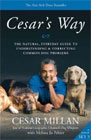
Cesar's Way
Cesar Millan
Hodder Paperbacks (7 Feb 2008)
ISBN-10: 0340933305
ISBN-13: 978-0340933305
Cesar's Way tells the story of how Cesar Millan went to California and became famous for his work with dogs. The book also sets out what Millan believes that Californian dogs need to have happier lives and get on better with their owners. Millan arouses passions. He has a large, enthusiastic following, but has also been criticised for taking back training to the days when every whisker twitch was seen as a sign of dominance, and for using some harsh techniques; the dark days before ethologists began to reassess their views of wolves, and before Karen Pryor made operant conditioning fashionable in dog training, with her 'Don't Shoot the Dog'. So is Millan God or the Devil? The answer, of course, is neither. His approach has some strengths, and much of what he says is relevant to European owners, but he is also a showman, with a very partial vision of dog human relations, and can only really be understood in the context of Californian dog culture.
First, Millan is undoubtedly talented. He has a 'way' with dogs, and obviously enjoys their company. He especially likes powerful breeds such as pit bulls and rotties, which are under threat from breed-specific legislation. It is refreshing to see a trainer who champions these breeds, and who is happy to train children to handle the family rottweiler or pit bull. He spells out that many attacks against humans are the result of owners using dogs as weapons. Once a breed gets a reputation as 'badass', human delinquents find them attractive and try to train them to attack other humans. Yet even these dogs can be rehabilitated. He also points out that small dogs can be very mean and snappy at the grooming parlour - his career in the US began as a dog groomer. Powerful dogs need responsible owners simply because they are powerful, not because they are especially mean.
Responsible owners make it clear to dogs what is acceptable and what is unacceptable behaviour, and are consistent in applying rules. Some owners see training as ending once they leave an obedience class, and Millan is right to stress that dogs need leadership, need to be reminded of house rules, all the time. Training goes beyond teaching a few commands which are then sporadically enforced.
Millan is also obviously right when he stresses the importance of exercise. One cultural trait of Californians that shocks many Brits is that Californians often don't walk their dogs. As Millan points out, walking is good for both dogs and owners. A good long walk first thing in the morning can help cure 'separation anxiety'. The dog is tired and relaxed, and just falls asleep when the owner leaves. A big 'yard' or garden is not enough, dogs benefit from leaving the area where they are confined every day, and from walking with their owners.
Owners should be 'calm-assertive', Millan stresses, and this stress on being calm is very helpful if you want your dog to be calm. Fussing a fearful dog can make the dog more fearful. Throwing balls excitedly in mindless ball games can make dogs overexcited. It's more useful to include elements of control, such as getting the dog to sit before throwing the ball, and teaching the dog to return the ball nicely. And if you don't want to be mobbed when you come through the door laden with shopping, it helps to wait until your dogs are calm, and then greet them with affection. It is perhaps an Anglo vice to tend to get dogs overexcited with cuddles at inappropriate times, and too much fussing. Millan comes from a different dog culture where dogs are fussed less. A focus on being calm not only helps dogs to behave better, it helps owners to feel they are in control, so helps owners to behave better.
Millan is singularly tactful with owners. Many viewers might want to shout, for example 'Take that dress off that dog, it's a dog, not a doll, for goodness sake!'. But Millan gently bulldozes his points across, all the while showing empathy with his clients. A cynic might say that it is easy to be tactful when your clients are rich and powerful people. Even so he does show that he understands where clients are starting from, and uses self-control in showing them where he thinks they should be, and how to get there. He is also quite happy to accept clients' desires to treat their dogs as friends, so long as they remember that dogs are also dogs, and so long as owners do not overload their friends with their emotional needs.
So Millan makes a lot of useful points. What of the weaknesses of his approach? First, he is very much a showman. Sometimes he is not so much telling owners how they can handle their dogs better, as telling the world that he can handle dogs better than anyone else. For example, alpha-rolling a dog, turning it on its back to achieve submission, can look impressive on camera, but can also be a good way for humans to get bitten. A dog might bite in a panic, if it is not used to being rolled, for example. Gentle rolling may be useful, when dogs are relaxed, to teach them to be more comfortable at being turned on their backs, 'Alpha rolling' is not usually very sensible, certainly not for an owner who has trouble controlling their dog. Cesar Millan's TV shows might also give the impression that he is a magicion who can supply a quick fix, though obviously solutions involve a lot of hard work and commitment on the part of the owners.
Millan also plays down the role of obedience classes, which is a pity, because they can be extremely helpful in teaching owners how to control their dogs. He is described as a 'canine behavior expert' rather than a trainer, and he stresses that teaching a few commands may not tackle serious issues arising from lack of exercise and discipline at home. This is very true, but a good obedience trainer will ask owners about how their dogs behave outside class, and will give guidance on how to use commands at home, how to provide leadership, and how much and what sort of exercise a dog needs. Distancing himself from obedience trainers could give readers the impression that training is not necessary, all you need to do is 'walk the walk' and be calm-assertive.
A further worrying issue is that Millan could give the impression that all dogs' problems are caused by their owners, and can be solved by using his methods. True, many saveable dogs are euthanased for 'behavioural problems', especially in the US, but there are some dogs which are born with temperaments which make them too much of a risk for most owners, or which suffer from illnesses, such as brain tumours, which cause aggression. Poor temperament can also be a problem in many 'family breeds' such as golden retirievers, when dogs have been bred for money with no regard for temperament. It's well worth problem dogs having a vet check, because no amount of calm assertion can cure Lyme disease, or a brain tumour. A vet check can save a lot of tears.
The 'gung ho' advice that dogs shouldn't pee on the first stages of their walk, but should be frogmarched, is geared to the needs of rich Californians with enormous gardens. Many British dogs have a tiny yard, or no space outside the house at all, so they may be bursting to 'go' on the first stages of a walk. If they are not allowed a pee, you may end up dragging a urinating dog, or a dog desperately trying to do a dump. Dawdling is one thing, but biological needs should be recognised. Likewise, if a dog indoors tells you he needs to perform, or to vomit, it is worth listening, unless you want to clean up a mess on the floor, which may come from both ends. Yes, leadership is important, but a good leader should be able to listen as well as give commands.
So what of Millan's view of packs? Curiously, his 'pack' is not a pack in the normal sense of the term, it is too big to be a 'natural pack', and is not allowed to develop a hierarchy. Rather, he sees his role as being dominant over all the dogs, rewarding the dog that shows the best behaviour. Millan has yet to explore in depth the concept of a pack, and its usefulness in understanding groups of dogs that live in our homes. What he says about packs is not yet developed enough to be graced with the term 'pack theory'. It is a fairly macho Hispanic view, with the emphasis on 'you gotta be dominant'. There's little exploration of ways in which the social behaviour of dogs may differ from that of wolves, and the variations within wolf and dog societies.
Has Millan taken training back to the 'Dark Ages'? Perhaps he is better seen in terms of a pendulum, part of a swing away from an extreme American position on training called 'pure positive'. People who claim to follow 'pure positive' methods argue that dogs should be trained only with positive reinforcement, with no punishment at all, taking their arguments from concepts and ideas used in operant conditioning. Now this may sound fine, until you start to think about it, and look at the solutions such trainers propose.
In operant conditioning terms, punishment is not 'doing something a dog does not like' but doing something that stops unwanted behaviour. Saying 'chsst' to a dog sidling up to the table to eat your dinner is punishment, if the dog stops sidling up to the table. Whacking a bemused pup because you have found a puddle, is not punishment, in operant conditioning terms, if the dog is clueless as to why you have whacked him. It's just unkind and stupid. If your dog wants to go out for a walk, and is overexcited, barking as soon as you open the door, your shutting the door until he calms down is punishment. If you turn a hose on dogs to stop a fight, and the dogs instantly stop, that is punishment. Try stopping a dog fight using positive reinforcement alone, and you could end up with injured dogs.
Trainers who claim to use positive reinforcement alone generally use punishment as well, ie they are not being totally honest. Any trainer who tried to use just positive reinforcement would be complicationg their lives unnecessarily, and it is perhaps unfair on the dog to withold information about what you don't want him to do. British trainers tend to use the term 'reward-based training' rather than 'pure positive', because it is more accurate. Most trainers agree that too much punishment in the operant conditioning sense, can be counter-productive, have unpredictable side-effects, and can undermine trust. Reward-based training can be much more fruitful for dogs and owners,
So Millan is correct in his comment that an approach using only positive reinforcement would be unhelpful, especially with the more seriously damaged dogs he deals with. However, he muddies the waters when he claims that punishment is wrong. In operant conditioning terms, his methods do involve punishment, though he uses the term 'correction', for example, a leash tug that stops a dog from lunging towards another dog. The problem is that punishment has one meaning in everyday language, and another in operant conditioning terms. When Millan says that punishing dogs in anger is wrong, eg beating the bemused pup for the puddle, he is using punishment in the everyday sense, which is confusing, in a paragraph where he is also using 'positive reinforcement', an operant conditioning term. Whether he relies on punishment too much is another issue. Millan's stress on dominance will certainly seem like overkill for owners whose dogs need a very light touch, and which grovel if you just use a stern tone. Many dogs are highly responsive to their owners, and going over the top on dominance can be counterproductive by undermining trust.
Though Millan does say that it is important to be calm, he could usefully stress trust a little more. Trust makes it easier to get dogs to do what you want, especially if you want a dog to submit to being examined. Gentle, firm, calm handling can help to promote trust, while rough handling is likely to undermine trust. 'Hands off' methods of training may also create dogs which are unused to being handled, unless owners counterbalance them by some gentle, firm handling, which prepares a dog for vet examinations, or even inept caresses by people unused to dogs. Likewise, Millan argues for consistency in order to achieve consistent obedience, but he could go further, Inconsistency undermines trust. Owners may appear dangerously unpredictable if they berate a dog one minute for, say, begging, then encourage the dog to beg by giving it titbits while they are eating. Dogs may well bite an owner who seems dangerously unpredictable, not when they are being berated, but when the owner approaches with the titbit - which might seem a prelude to another 'attack' by the owner.
There is some truth in the criticism that Millan's popularity has set the clock back in his discussion of aggression. He uses a similar model to Bruce Fogle in 'The Dog's Mind' describing 'dominance' and 'fearful' aggression - which Fogle sees as opposites. This model is unhelpful for owners, who may well have dogs which both threaten them in ways called by Millan as 'dominant', and which bite in a panic if the owners tries to examine them. Owners not only need to be leaders, also leaders that their dogs can trust. His advice that owners should not roughhouse their dogs, or play tug with them, in case it encourages the dogs to be dominant, could do with some explaining. Obviously winding up a dog by smacking and pushing it is not sensible, but gentle wrestling can help to develop trust with a dog, and encourage the dog to submit on command. Likewise, tug games which have a built-in 'drop' command can help to reinforce the owners' control of their dogs.
Millan does not mention territorial aggression, which is a useful category because it helps in understanding why dogs may get on well with others in the same household, yet attack strange dogs. Walks are of course useful in teaching dogs to tolerate strangers. Nor does Millan mention predation as an explanation for why dogs may attack, but this is important because when dogs see another animals as prey, they go in for the kill. Millan would benefit from reading some recent work by biologists on aggression, and on differences between wolves and dogs, such as Miklosi's work mentioned in the reference list below.
Perhaps what is most lacking in Millan's book is a sense of what can be achieved when dogs and humans do communicate well. The stress is on controlling animals that have got out of control rather than on developing a relationship with dogs that owners already feel comfortable with. He perhaps loses sight of some of the subtlety of dog-human relations when he admonishes owners not to 'humanise' their pets, and stresses their difference from humans, a very Hispanic point of view. Does 'humanisation' explain the problems of Californian owners? Only to a very limited degree. Yes, people sometimes see dogs as little humans, and yes, owners need to understand ways in which dogs' perceptions and abilities are different from ours. But in many cases, Californian owners seem to see their dogs as plush toys rather than little humans. Indeed, it might help if owners asked how they would feel if they were left at home alone all day, just let out in the garden for brief periods when the owner got back home from work, never taken out of the home and garden, never given anything interesting to do. How might a human react? And how would human children turn out if no-one told them what was acceptable and unacceptable behaviour, and if rules were not enforced consistently. One reason why humans and dogs can get on is that we have a lot in common.,
True, Millan is right to stress the importance of smell and body language for dogs, and the uniquely human reliance on language, which we cqnnot expect dogs to understand in the same way we do. But some dogs have remarkable abilities to understand human language, especially nouns or verbs relating to activities they are interested in, such as 'walk', 'ball', 'sniff' or 'fetch'. The work of Csanyi (see reference list) and his team on communication between humans and canines is particularly interesting.
So Millan is neither God nor the Devil. He is a talented trainer who has used insights from Mexican dog culture to help Californians. His book is well worth reading if you are interested in dog cultures. The Californian owners may surprise you. Millan's advice that dogs need exercise is less likely to be a revelation.
Millan's message cannot really be understood outside the cultural context in which he is working. It's not just that many US owners don't walk their dogs, and many trainers have wandered up a theoretical cul-de-sac, American dog behaviour specialists are more likely than their UK counterparts to have little practical experience, and tend to rely more on drugs to control behaviour. British behaviourists tend to have more practical experience as trainers. The UK Association of Pet Behaviour Counsellors requires members who specialise in dogs to have practical training skills, as well as academic knowledge.
Furthermore, puppy farms and pet stores carry more weight in the US, as sources of dogs, so there is more chance for a pup to be poorly bred and poorly socialised in the US, then acquired on impulse by someone wanting to 'save' the little guy from the pet store. Impulse buys are often discarded, so once the pooch becomes unmanageable, it is off to the shelter, where, as Millan notes, over half the dogs that go in will come out dead. Preventing dogs from being turned in to the shelter can save their lives. It is in this context that Millan preaches tough love.
So this book is certainly worth reading, but if you feel your pooch is something of a delinquent, it offers no quick fixes. Your best bet is to find a good trainer who sees training as important outside the obedience class. A book cannot replace someone who can see you and your dog in action, and comment on your timing, and the message you are sending your dog, as well as the messages your dog is sending you.
|

Click on the cover above
to go to this book
at Amazon.co.uk
|
Cesar's Rules
Cesar Millan
Hodder & Stoughton (3 Feb 2011)
ISBN-10: 9781444706307
ISBN-13: 978-1444706307
ASIN: 1444706306
'Cesar's Rules' is a very interesting book. It is far from being a simple 'how to train your dog' guide. To start off with, Cesar Millan is ambiguous about the importance of training, a term he uses to refer to formal obedience training, or training in skills, like sniffer dog work. Millan quite rightly points out that dogs may be well-trained, ie able to obey a wide range of commands, but still cause their owners serious grief. So in his view, training is secondary to fulfilling dogs' needs, especially for exercise and leadership. Millan claims to train humans and rehabilitate rather than train dogs, and in the introduction, he explains that he called in the help of professionals since he did not see his own expertise as broad enough for writing a training book.
What is training?
It is clear that Millan and his co-author have been listening to their critics. The book is much more carefully written than their previous works. Even so, a broader definition of training would be helpful, if only to remind owners that every single interaction with our dogs teaches the dogs something, so training happens all the time, not just during formal training sessions.
Millan came from Mexico, where the dogs he met were often well behaved, but not formally trained. In Chapter 1, Millan describes how he worked for a time as a kennel boy at a training facility in Los Angeles, where he realised that obedience training wasn't helping many of the dogs with serious behavioural problems. So Millan has good reason to doubt the usefulness of formal training. Likewise, I live in a village in the middle of Spain. Few dogs here are formally trained. Few will sit on command, though most have reasonable recall, yet most I meet are reliable off-leash, respect livestock, and don't mess with passing humans or passing dogs. This is more than can be said for many 'obedience trained' UK dogs.
How did Cesar's Mexican and my Spanish village dogs get to be well-behaved? Before owners ever went to trainers, they trained pups in the same way as they trained kids, by spending time with them, and explaining what to do, and what not to do. The Spanish word for manners training is 'educar', or 'to bring up', used for both dogs and kids. Informal training is just teaching dogs rules, such as 'it's OK to chase rabbits, but not chickens'. As Ian Dunbar notes in 'Cesar's Rules', commands, such as sit, or recall, help impose those rules.
Often we don't realise how much training we do. When I brought home a stray ex-hunting mutt, Toby, he jumped on the table and tried to share my dinner, and was very snarly at meal-times, attempting to savage my foot if I went near him when he had food. (It was quite comic, because he is not very big.) My other dogs had been trained not to jump on the table without my realising it. Toby, I learnt, had been kept outdoors with bigger hunting dogs, and had been trained that he needed to fight to be able to eat. I was his fourth owner, and he had been dumped in the countryside for fighting the other dogs he lived with in a stockyard. He had to be taught the rule 'everybody eats from their own plate, and leaves the others in peace'. This just involved standing in the kitchen when the dogs ate, and saying 'chsst' if they approached another bowl. When he realised that the rules helped him eat in peace, he calmed down. A lot of everyday training is a very undramatic learning of rules, such as 'you don't mess with cars, you sit at the kerb beside me, and the cars don't mess with you'.
'Whole dog training' is easier here, because dogs have more freedom to be off-leash than in most parts of Europe. They could be off-leash much more in 'the old days', because there were fewer cars and fewer legal restrictions. Most owners in developed countries now face more difficult conditions. Off leash training is less easy now because streets are more dangerous and there are more leash laws. There are fewer dogs, so we have less experience of them, and we have lost some of the skills we used to have. We often take on more difficult dogs than the neighbour's mutt pup of yesterday, and we are now hedged with more restrictions that prevent us training easily. We are often out working for long periods, and come back tired, to find a hyped-up dog desperate for a run. Many of us turn to professional trainers for help.
Among dog professionals, there is a separation between 'trainers', who teach owners with all kinds of dogs, and 'behaviourists', who specialise in problems between owners and dogs. ('Behaviourist', confusingly has two meanings, a specialist in canine behaviour problems, and a follower of a school of psychology called 'behaviourism', of which more later.) Yes, there are 'trainers' who see their job as just instructing owners to teach dogs to obey a few commands. It's unfortunate that, at a time when owners have more need of professional help, people can call themselves 'trainers', and fail to see the 'whole dog'. However, there are many dedicated trainers who do a similar job to Millan. They help owners to use commands to teach their dogs rules, which is 'real training'. Good trainers look at the owner, at messages owners may unwittingly send their dogs, at what owners may unwittingly be training their dogs to do. Good trainers also look at non-training issues, like exercise, diet, and the environment the dog lives in. In practice, there is little difference between a good trainer and a good behaviourist, certainly in the UK. So yes, Millan is quite right, just teaching a few commands doesn't mean that dogs behave well. However, for the sake of owners, who sometimes we need to be reminded that we are training our dogs all the time, and in tribute to the real trainers, who go beyond simply teaching commands, it would be helpful if Millan developed a broader definition of training, such as 'whole dog training'.
This is not a 'how to' book!
Why do we train dogs? Mainly because we want them to behave in certain ways, and respect certain rules. There is a very interesting summary of what owners want from their dogs in Chapter 2. It's presented with little discussion, mainly to point out that owners tend not to want much, and what most of us do want is quite easy to achieve. I feel there's a lost opportunity here, because the survey could be a useful starting point for the 'how to' part of 'Cesar's Rules'.
Top of the list of what owners want is recall. Here the survey could be more strongly linked to advice on teaching dogs to come back when called. Then comes getting on with other dogs and people, especially kids. Again, this could be more strongly linked to training advice, both advice on teaching dogs how to respect and tolerate kids, and kids how to respect and tolerate dogs. Millan's insights into the abilities of well-behaved, confident dogs to teach other dogs are also relevant here. What else do owners want? The next highest wish in the survey is that we want dogs to refrain from trashing the house, and/or howling when we are out. This point could be more strongly linked to Millan's emphasis on fulfilling dogs' needs for exercise. As a local vet commented, when I mentioned that Toby had recently eaten a Spanish-English dictionary (a small one) 'He's bored, take him out more'. Training is relevant here (eg teaching the rule that books and CDs are not permitted, chew-bones are), but Millan's emphasis on looking at the whole dog is more relevant.
Linking the Chapter 2 survey more strongly with advice would have given 'Cesar's Rules' much more coherence as a 'how to' book. but this book is more than a guide on how to train, it is also a discussion of different approaches to training, something of a change in direction, and a defence of Millan's own approach in response to some quite vociferous criticism.
Many people enjoy arguing about Millan in terms of 'for' or 'against'. Humans are like dogs in that we like to do things in groups, like groups pro or contra Millan. 'Terrierman', a popular blogger quoted by Millan in 'Cesar's Rules', is a Millan fan, and defends Millan against criticism. ('Terrierman's Daily Dose' sounds like it was written by a Jack Russell at a computer, and is well worth reading if you like a little intelligent invective and passion for dog training.) Luckily, Millan has some humility and does listen to his critics. And, as he notes in this book, there is far more to training than just defining oneself as in one camp or another.
The mature Millan
Millan was initially criticised for being overly confrontational, and for putting too much emphasis on dominance and punishment. The young Cesar could easily fit into the Spanish village where I live. Men here feel that they should show physical courage, let a dog know who is boss, and they tell you that dogs and kids need discipline. I hear this a lot from people around me. (Curiously, men are also seen as in need of discipline from their wives.) Confrontation makes for dramatic TV, but that is not the only reason why Millan became very popular very fast, he was also addressing a need. Much of what he said was simple common sense that some Californians had forgotten, dogs need walks or they tend to become a little hysterical with 'cabin fever', and if you don't spell out what the house rules are, dogs will make their own rules.
'Cesar's Rules' reflects a mature Millan. He no longer needs to prove he has balls, physical courage. He recognises that most owners don't have his skills for 'reading' dogs, or his timing, so they may end up being bitten if they try confrontational methods that he can get away with. He also recognises that confrontational methods can cause unnecessary stress for dogs. Whether or not to confront is an art, rather than a science. The question is 'will tackling this head-on solve the problem fast, or will it make it worse?', and the answer really only comes from experience, knowing what you feel inside, and reading the dog. Millan's recommendations in 'Cesar's Rules' are for a much less confrontational approach than that shown in his early TV programmes. He has also moved on from his earlier crude model of 'dogs as wolves', of which more later.
Millan explores behaviourism
A great strength of this book is its exploration of behaviourism in Chapter 3. Behaviourism is an approach from psychology that dominates the orthodoxy in US and UK training. It links learning and behaviour to rewards and punishments. Millan and his co-worker's previous mentions of behaviourism were a reaction to people who call themselves 'pure positive' trainers. Millan thus perpetuated the myth that there is such a beast as a 'pure positive' training. This is, of course, nonsense. 'Positive' in behaviourist theory just means 'adding something', either adding a reward to reinforce a desired behaviour, or adding a punishment, to decrease undesirable behaviour. Someone who believes strongly in administering punishment could thus logically describe themselves as 'pure positive'. Furthermore, while it is certainly true that harsh punishments can undermine trust, to argue that dogs can be trained without 'adding something that stops a behaviour' is to paint oneself into a corner.
So people who claim to be 'pure positive' have an imperfect understanding of behaviourism, or are not being entirely honest. Even if you did study behaviourism thoroughly, it would not take you very far on its own as a way of understanding how dogs learn. A key weaknesses of behaviourism is that it is not clear whether 'punishment' is a stimulus that a dog doesn't like, or whether, as Ian Dunbar puts it in Chapter 3 of 'Cesar's Rules', just something that makes a dog less likely to behave a certain way, without necessarily being unpleasant for the dog. Now, if you have a good relationship with a dog, and say 'please don't do that' (eg chew the chair leg), chances are the dog will listen and obey, and eventually stop chewing the leg (especially if you offer a chew-toy as a permitted chewable object in place of the chair leg). A good relationship means trust, and wanting to know what the rules are, because rules can make the world a safer and more enjoyable place to live in.
In good relationships, most dogs and people can handle the message 'I love you but'. Millan himself illustrates this when he tells owners that they have screwed up with the best of intentions and need to change their ways. He builds trust with his message that the owner is a good person who wants the best for their dog, and then adds something - criticism - that changes the owner's behaviour. Millan has a talent for developing trusting relationships fast. So the reason for the ambiguity in the behaviourist definition of 'punishment' is that there is a lot more going on between dogs and people with a good relationship than behaviourism can adequately explain. Ian Dunbar hints at this when he argues that punishment does not have to be aversive, because humans training dogs are in a different position from computers shocking rats (Chapter 3 p101).
Studying behaviourism can help owners become better trainers, for example, it can help us realise when we are rewarding bad behaviour without realising it. But it is not a lot of use unless supplemented by an understanding of human-dog relationships, and, as Millan notes at the end of Chapter 3, behaviourism ignores canine inbuilt tendencies.
Millan's last sub-heading in Chapter 3 is 'Dog Training vs Dog Psychology'. This subheading implies that training is the application of behaviourism, and is possible without understanding what makes dogs tick. Yet real training has to take into account the nature of dogs, and the relationships of dogs with their owners. Real trainers have built up an intuitive understanding of the nature of dogs from spending a lot of time with them, and learning from them. This is true as much for 'natural trainers', who practise informal training, as for professionals who help owners with training their pet dogs. So here, I disagree with Millan, there's just no way one can do 'whole dog training', and help owners achieve a better relationship with their dogs, without going beyond behaviourism.
The main weakness of behaviourism, then, is that it looks at responses to external stimuli, rather than at what is going on inside an animal, its feelings about what is going on in a relationship, or inbuilt desires to do some things, desires which override any rewards that owners might offer. Some people learn about the nature of dogs just by being with them a lot. In the academic world, ethologists have systematically studied canine inbuilt tendencies. Ethology was popularised among 'dog people' by Bruce Fogle. whose 'Dog's Mind' was very influential in the early 1990s.
The nature of dogs, and how they learn from each other
Millan was initially a great fan of Bruce Fogle, Fogle popularised the idea of using wolves as models for what dogs are really like. We may put Fluffy in a little dress, but she is essentially a designer wolf. The young Millan found Fogle's view of dogs as wolves especially appealing. Fogle's message was that wolves have strong hierarchies, so humans need to show dominance in order to control dogs, and this fitted with the young Millan's view of dogs. Since Fogle's work was published, a lot more has been learnt about wolves, and ways in which dogs differ from wolves for example, the work of Adam Miklosi's team in Hungary. Miklosi's team has raised wolves, and compared their development to that of dogs. They have spelled out important ways in which dogs differ from wolves. For a long time, Millan seemed deaf to criticism that his ethology was flawed, but this is starting to change in encouraging ways.
The mature Millan is much more cautious about using the term 'dominance', and he seldom uses the term in 'Cesar's Rules'. He has moved on from Fogle, but is endearingly loyal to his early hero, whom he mentions at the end of Chapter 3. Of course all of us are likely to be seen as 'old fashioned' by later generations. Much of human knowledge is cumulative, we build on the backs of those who have gone before us. Fogle helped owners to understand that their pooches were not little humans, but in some ways were like wolves. His arguments were often flawed, but there was still some truth in them. Dunbar, and the late John Fisher (a key figure in British dog behaviour) wrote some very dubious ethology before they moved on. We are all human, we often screw up with the best of intentions, but we can learn from our mistakes. Now that Millan has moved on, it would be good to see him learn from more recent research, and think a little more about what he calls 'the power of the pack'.
Millan often notes how dogs can influence each other for the better, and there are several mentions of this in 'Cesar's Rules'. Well-behaved, confident dogs can help other dogs to become well-behaved and confident. Sometimes dogs can teach each other faster than we can teach dogs - for example the story of Daddy and Viper in 'Cesar's Rules'. Yes, this is wonderful to watch, and it's a strength of Millan's that he is able to understand and use this canine ability. However, calling it 'the power of the pack' is perhaps misleading. Dogs do not have packs in the same way that wolves do. Dogs are far more flexible than wolves. They can learn to get on with dogs they live with, and a range of other dogs in different situations. Not every group of dogs is a 'pack' in any meaningful sense, even if they live in the same house. They have not chosen to group together and can't escape from one another, unlike wild wolves. They may hate each other and try to rip each other to shreds at the first opportunity. Even if they are like a 'pack' in the sense that they coordinate their activities and get on well with one another, they can teach each other bad habits, like barking at bikes.
Dogs from different households that are often walked together may form a sort of 'pack', in the sense that they act as a group, for example, sniff grass together. However, in no way do all the dogs in a park form a 'pack', and there is no reason why one's own dog should be forced to interact with them. Some dogs are ill-mannered, and overexcited on account of too little exercise. Perhaps a fond notion that all doggies one meets on walks should play with one's own doggy, because they should all form a big happy pack, is a major reason for dogs developing 'dog aggression'. I'd love to see Millan define and explore the notion of the 'pack', from his own wide experience, combining this with insights from the work of modern ethologists like Miklosi. It would be especially useful for people who come into contact with dogs a lot when they go out on walks.
Teaching skills to dogs
Dogs with particular skills appear throughout the book, such as Viper, the highly trained and neurotic cell-phone detection dog. Millan also describes the work of his early heroes, Hollywood trainers, in Chapter 5. He looks at 'herding', hunting, protection and cancer sniffing dogs in Chapter 8. He is aware that some dogs, of a type a friend once described as 'busy' dogs', need interesting things to do, or they tend to get up to mischief. Millan has helped to publicise and promote skills training, but perhaps both he and most pet dog owners underrate the enormous benefits that most owners could enjoy from teaching their dogs skills. Chapter 4 sets out 'Cesar's rules for a teachable dog', and there is no mention in these rules that dogs need jobs. The survey in Chapter 2 shows that most owners surveyed place a low value on skills training. Maybe Millan focuses on fire-fighting because that is what people ask him to do, but skills training is so useful, I believe his 'rules could do with an addition: 'Dogs Need Jobs'.
Skills training can help dogs and humans learn to communicate better, trust each other more, and take more enjoyment in each other's company, so it can go a long way to solving behavioural problems. In particular, teaching retrieving includes teaching dogs to drop precious objects on command. It's a useful way of preventing and tackling 'resource guarding', and of course can be helpful if you want an object retrieved that you can't get to and the dog can. Skills training is where a real partnership begins between dog and owner. The dogs are doing activities that are natural to them, and are rewarding in themselves, such as using their noses.
Millan has adopted a term from Ian Dunbar, 'life reward', to describe a task that is a reward in itself. Though Dunbar and Millan have different approaches, they found they had a lot in common when they met. Like anybody passionate about a particular field of study, Millan is happy to learn from anyone who has something useful to tell him.
Cesar Millan and Ian Dunbar spend a couple of days together
Millan's meeting with Ian Dunbar is described in Chapter 6, which focuses on Dunbar's work, and his approach to off-leash training. This is a curious chapter. Millan is suitably deferential to this high-ranking male, mentioning Dunbar's qualifications, achievements, attractive wife, and genial personality. The two shared some beers together. I do wonder whether the beer accounted for some of the statements attributed to Dunbar. He appears to part company with reality in his 'seven rules', which include advice to select an eight-week puppy that's "housetrained, chew-toy trained, has been taught to come, sit, lie down and roll over on cue, and has been socialized and handled by at least 100 people." (p191) Any pup whose owner subjected him to that regime before eight weeks could end up a nervous wreck. You can start housetraining a small pup, but it would not be fully housetrained at eight weeks, simply because dogs do not develop full bladder control until later. It's useful for pups to meet children, men and women when they are small, to get used to different voices and ways of behaving, but being handled by 100 people is not necessary, and indeed would probably be very stressful. Did Millan double-check with Dunbar that he really meant this? Did Dunbar see the book before it went into print? Was it responsible for Millan and his co-author to quote Dunbar so uncritically?
Dunbar's advice "always have your visitors offer your puppy/dog a treat" (again in the 'seven rules') is also impractical. Firstly, some visitors don't want that sort of close contact with dogs, and there is no reason why they should have to tolerate it, especially if dogs make them nervous. Secondly, having visitors always fuss and treat dogs can encourage them to become overexcited when visitors arrive. My mother used to teach 'esoteric subjects', and read tarot cards at home, with her two dogs lying quietly in their baskets on the other side of the room. Her advice to her many visitors was much more sensible 'Just ignore the dogs'. Yes, they did occasionally sneak a cuddle from a particularly dog-friendly visitor, but when both dog and visitor had decided they liked each other.
'Hands off' or 'hands on' training?
The whole of Chapter 6 focuses on 'hands-off' methods, which have tended to dominate professional training in the US and UK. As Dunbar explains in this chapter, the idea is that rough handling can undermine trust, so it is better to have no handling when teaching commands. "Most human hands cannot be trusted. Of all the humans who can't be trusted with their hands, I guess men and children are probably the worst. They do a lot to dogs that that spook dogs out" (p162). Dunbar uses treats and his voice, eventually phasing out the treats. Millan himself mentions at the end of this chapter that he prefers touch as a more natural way of teaching dogs. Dunbar is right in that many people do spook dogs by the way they touch them, but surely the solution is to teach people how to touch dogs.
Trainers and dog behaviour specialists tend to see novices, or people with difficult dogs. They don't tend to meet people who have successfully brought up dogs to obey rules. This can give trainers a bleak view of pet owners, and maybe Dunbar underestimates what most owners are capable of. Most people can understand and follow basic advice if they realise that it is very important.
There is a big disadvantage to 'hands off' methods. At some point, dogs have to learn to be handled. Pups that are trained with 'hands-free' methods may not learn to trust hands. Gentle, firm handling which is sensitive to the dog's reactions can help to foster trust, whether it's part of formal training, or just part of everday interactions. There's also no point handling dogs appropriately when they are being formally trained if they are handled inappropriately at other times. All handling involves training. I have a particular interest in this on account of having taken on an ex-hunting mutt, used to living outdoors with little handling, and much of that somewhat rough, so he is warier of being handled than the average pet. 'Hands-off' methods simply don't address the problem. Dogs do need to learn to accept handling, if they are going to get veterinary attention, and be reasonably safe around people.
There's another disadvantage to hands-free plus voice methods, which is that they are less useful with deaf dogs than are touch and gestures. Most owners don't start out with deaf dogs, but dogs often go deaf as they get older. My eleven year old bitch is now almost totally deaf. Luckily she has had a lot of handling, so touch calms her. Turn her on her back and stroke her belly up to her breast bone, and she closes her eyes and nods off, super-relaxed. She has learnt to trust me, and to 'read' me well enough for us still to be able to communicate pretty well.
Millan, then is outside the orthodoxy, in his use of touch, but, now that he has matured and moved on from his 'lion tamer' youth, his skills in understanding how to handle dogs are very relevant for pet owners. Millan's experience as a groomer taught him a lot about how to touch dogs, and was a strong foundation for his later work. How pups are handled affects how they respond to touch as adults. Handling nervous adult dogs is perhaps difficult to teach in a book, because much of the skill of knowing how and when to touch comes from 'reading' dogs, which comes above all from experience. Even so, I'd have liked more in 'Cesar's Rules' on how to handle dogs, because this such a basic skill, and is one of Millan's strengths.
There is, alas, a simple economic reason why 'hands free' methods have caught on, which is that becoming a professional trainer involves less skill. It takes a lot more skill to teach owners how to handle dogs, but if training is used in its wider definition, if it is what we teach our dogs all the time we are with them, then this is a skill that trainers need to understand, and owners need to learn.
Read this book!
Like any book, 'Cesar's Rules' is not perfect, especially if what you want is a simple 'how to' training book, though it contains plenty of useful training advice. Millan is a 'natural trainer' who has learnt by trial and error. What he does comes from a gut feeling developed from experience, so it is sometimes difficult for him to describe how he trains, especially as he defines training narrowly, and does not even see himself as a trainer. More than a 'how to' book, this book is also an exploration of different views, and a pooling of different talents. It's a book that will activate a few brain cells, force you to think and look at your dog, which is a pleasant change in the world of dog books.
Alison Lever
Thank you to Diana Attwood, Wendy Hanson, Tiffany Jho and Janeen McMurtrie for helpful discussions and arguments about this book. Thanks also to Berit Aherne, a 'real trainer' who first taught me about what dogs are capable of. |
|
| |
References (click on the titles for reviews of the books)
The book that made operant conditioning fashionable in dog training was
Don't Shoot the Dog: The New Art of Teaching and Training
by Karen Pryor
For a clearer account of the way operant conditioning is used in dog training, see
How Dogs Learn
by Mary Burch and Jon Bailey
However, despite the title of Burch and Bailey's book, please note that operant conditioning is not the only way to understand how dogs learn. It can be a useful explanation, but has limitations, for example in understanding the work of tracker or sheep dogs.
If Cesar Millan wants to try updating his knowledge of wolf behaviour, and what it can teach us about dogs, he could usefully read
Dog behaviour, Evolution and Cognition
by Adam Miklosi
And if he wants to know more about research on canine cognitive skills, he could usefully read:
If Dogs Could Talk: Exploring the Canine Mind
Vilmos Csanyi
Top
of page
|
|
|


