Dogs: Dogs and Diet
There are reviews of several good books on dogs in Books on Animals.
See also:
 Dogs: Choosing a Dog Dogs: Choosing a Dog
Dogs: Bringing up Your Puppy
Dogs: Basic Training
Dogs: Finding a Training Class
Dogs: Using Flexileads Safely
Dogs: Behavioural Problems
Dogs: Designing a Dog Garden
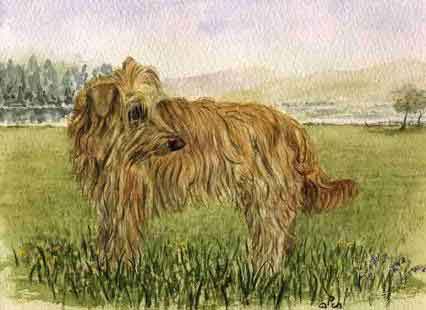
Trufa, who lives in Madrid. Spanish dogs often eat scraps
and rice.
Watercolour, painted by David Simon
Click on the picture to see me better
Diet is important
Diet is very important because it affects dogs' health and behaviour. It's also a vast area of study, with many fierce debates, such as what owners should look for in commercial foods, and whether home-prepared or processed foods are better. We offer some answers to common queries here, with suggestions for further reading, which will be especially helpful if you want to use home-cooked food - see References at the end of this article.
It's worth checking with your vet before making alterations to your dog's diet, especially if you want to give supplements, or if your dog has particular breed-related dietary needs, or special needs due to illness. You need to get the dosage right if you give supplements or you run the risk of giving your dog an overdose of some minerals or vitamins. Dogs may also have more than one medical condition, and you may need help to work out which takes precedence when making decisions on diet. Vets may not know a great deal about canine nutrition, unless they have developed a particular interest in the topic, but they do know about the common diet-related complaints that they see at their surgeries. The best vets are prepared to say when they can't answer your questions immediately, and will check out topics for owners, since they are better able to understand the relevant literature than non-specialist owners.
Sudden major changes in dogs' diets can cause digestive upsets, so make radical changes gradually, mixing some of the old food with the new. It's especially important to introduce new foods to puppies gradually. Pups can develop allergies if their diets change suddenly, so it's safer to try one food at a time and a little at a time.
What one should look for in a commercial dog food: Nutrients, ingredients and pet food labels
You're faced with an array of dog foods at the store. How can you decide what to feed your dog? First, check the labels and see what they tell you. You should find a list of both nutrients and ingredients, together with recommended servings. This won't tell you all you need to know, but it's a start!
Dogs need to have the right balance of nutrients, ie proteins, fats, carbohydrates, vitamins and minerals in line with ‘good practice’ in canine nutrition. However, the nutrients also have to be accessible to the dog. Dogs aren’t able to digest some foods well, for example, grain is not the best source of protein for dogs, and does not provide all the amino acids they need. Many dogs react to specific foods like maize and chicken, and of course they will be unable to benefit from nutrients in these foods if the foods make the dogs sick or squitty. So, the nutrients levels listed on pack and can labels don't tell you much on their own, you also need to check the ingredients.
Meat is a good source of protein for dogs, and it's a good idea to choose foods that have meat or fish as the main ingredient, which is listed first on pack and can labels. Other ingredients, such as cereals and vegetable derivatives may, however, add up to more than the meat and/or fish content, even if meat or fish head the list, and it's worth checking the actual proportions with manufacturers.
Is everything described as 'meat' in pet foods good for dogs? The ingredients lists on can and pack labels can be very vague, and may just describe meat as 'meat and animal derivatives', without saying which animal the meat came from. This can be a problem if your dog is allergic to certain types of meat. Other labels may give information on which animals or birds the meat comes from, but don't specify which body parts of animals are used. This could be, for example, beaks and feathers, or smooth intestine. The important issue should be what is good for dogs, rather than whether the source of food revolts you as a human. Wolves eat rabbits, skin, bone, stomach contents and all, and that is what they are designed to do, however revolting humans might find it. However, some things owners should worry about include drug residues in slaughtered animals used for pet food, or toxins resulting from E coli infections from long-dead animals. One concern about
commercial foods is that pet owners have little way of knowing about the quality of ingredients used.
Fish is also a good source of protein for dogs, and there is some evidence that oily fish provides protection against cancer, heart disease, arthritis, and skin disease. However, again labels give little information on what types of fish, and parts of the fish are used in dog foods containing fish.
Pet food labels may give information on vitamins and minerals, but do not always say what form they are in, which is important because some forms are more bioavailable - accessible to the dog - than others. There are disagreements on what constitutes the correct levels of vitamins and minerals, but canine nutritionists agree that it is possible to give dogs an overdose. The ratios may also be important, eg ratios of calcium to phosphorous, or essential fatty acids to vitamin E, and these may be difficult to calculate from information given on labels.
Additives
Owners may also want to subject their dogs to as little in the way of preservatives, colourings, flavour enhancers and other 'additives' as possible. Additives aren't always bad, and ‘natural’ does not necessarily mean ‘good’. Deadly nightshade is ‘natural’ and can kill humans, but many preservatives and colourings have not been around for long, so their long-term effects are unknown. There are also additives which humans can tolerate but which dogs cannot, so it's not necessarily safe to feed dogs with human food scraps that contain additives, like bits of bacon, just because you can eat them and they don't seem to harm you.
Common sense says it's best to avoid highly coloured food. Your dog doesn't care what colour his food is, and is quite happy if it is sludge brown. Smell, taste and texture are more important for dogs, and colourings are put there for humans. Avoiding highly coloured food means that you don't expose your dog to unnecessary risk. Flavour enhancers should also be avoided, not only because they may be harmful in themselves, but they may also incline dogs towards obesity.
Preservatives tend to be used in dry rather than canned commercial food, since canning is itself a way of preserving food. Once canned food has been opened it should be used on the same day, and any food left over from one meal should be stored in a cool place or in the fridge with a cover. There is some disagreement on whether dog-owners should avoid preservatives. Some preservatives, such as BHA may be carcinogenic, but evidence is mixed. Foods without such preservatives may be safer, however, dry commercial food without preservatives will deteriorate fast, so if you use a 'preservative free' dry food, you need to take special care to store it properly, sealed and in a cool, dry place, and use it before the ‘consume by’ date. Some foods have vitamin E added as a preservative, and this may be safer than BHA, but is also less effective as a preservative, so you still need to be very careful about using the food before its 'consume by' date. Food with
preservatives like BHA lasts longer - you have longer before the 'consume by' date expires - but you still need to be careful not to use the pack past this date, and check that the food you buy has some time to go before its 'consume by' date expires. Owners often buy in bulk, to save money, but it's no saving if you end up paying vet bills to deal with skin problems and other conditions from feeding your dog on dry food that has lost nutritional value.
Pet food manufacturers themselves may refrain from using additives, but it is unclear whether the ingredients they use already contain additives. The resulting product may thus contain additives, though none has been added in the final manufacturing process. A claim that a product is 'additive free' is then no guarantee of quality, and some additives may be harmless, or even beneficial, but it's a start, since it's more likely that there are no unnecessary colourings and the like. There may also be links between skin allergies and behavioural problems and certain additives, which is one reason why home-cooked foods can be superior.
Dry or wet food?
Dry food is cheaper and more convenient. However, it may also contain more grain and preservatives, because grain is easier to store dry than meat, and canning is a way of preserving food.
Dogs need to drink more water if they are fed dry food, and are more at risk from dehydration if they are fed dried food and do not have access to water. This is important since some pet owners remove water when they are out of the house or at night, in the belief that this will help with house training. Dogs are more likely to develop kidney and bladder problems if they are fed dried food and deprived of water. If you have to leave your dog very long periods, he will need water and someone to come in and let him out for a wee. If you can't get help with dog care, then at least give him access to water and a place where he can wee, eg a secure dog run with a roof, that he can get to through a dog door, and can't dig his way out of.
Some owners believe that crunching on dry food is better for dogs' teeth, but most dogs fed canned foods are also fed a crunchy mixer. There are better ways of protecting dogs teeth, such as giving them bones to chew on - see 'Does diet affect dogs' teeth and gums?' below.
What about extruded food?
Some dried extruded foods will swell up like a sponge if put in water - test your dog's food to see if it does this. Some owners fear that this type of food can cause problems by swelling up inside the dog. Diabetic dogs should not be fed extruded food, which may contain too high levels of simple carbohydrates.
Comparing pet foods: maths is important
You need to be able to do some basic maths if you are comparing wet and dry foods, to be able to compare like with like. First you need to remove moisture from the equation. You can do this by subtracting the moisture content from 100, which, for example, gives 25 for a food that is 75% moisture. Then divide the crude nutrient levels by 25 and multiply by 100 to give the dry-matter content percentage. So a food that has 8% protein levels and 75% moisture has a protein level of 32%, excluding moisture. It's also important to assess amounts per serving - a food may appear to have more of a vitamin if compared by dry weight, but if the servings are smaller, then the amount of the vitamin per serving will be reduced.
Obtaining information from pet food companies
Clearly, people whose dogs have special needs don't have enough information on pack and can labels on which to base an informed decision about which brand to buy. Even people whose dogs seem to thrive on just about any food may be worried about the lack of information on packs and cans. UK packs may, for example, may state that preservatives are used, but not specify which preservatives. It is worth asking the companies for more information. They may not answer your phone calls, letters and emails, but they will know that owners do care about what goes into their dogs' food. You will also be able to sort out which companies care about their reputations from the responses, or lack of responses you get. Some owners believe that expensive foods are better foods, but this is not necessarily the case. The cost of pet foods may just reflect the marketing budget, rather than the quality of ingredients, and the research carried out into selecting ingredients.
However, company that takes the trouble to answer your queries will care more about consumers that those which ignore you. One question to ask is whether ingredients vary according to what is cheapest on the market, or whether the same ingredients are always used. This is especially important for dogs which cannot tolerate certain foods - you need to make sure that manufacturers can guarantee that their products will not contain those foods. You can also ask about feeding trials, and the breeds of dogs used, their ages, how long the trials took, and whether companies have information on the long-term effects of using their products.
Rotating pet foods
There is a strong case for feeding adult dogs without special needs a small range of commercial foods by rotation, rather than feeding any one commercial food exclusively throughout a dog's life. New discoveries are regularly being made about canine nutrition, and it is possible that a food may be complete according to current accepted wisdom, but still lack important nutrients. If you vary the commercial foods you feed your dog, there is more chance that the dog will be able to find whatever may be lacking elsewhere. Dogs are also creatures of habit, and may dislike novel foods, so if they only eat one brand, owners may have problems if that brand becomes unavailable. Puppies need to have new foods introduced gradually, but once they have got used to a food this can be included in the weekly menu.
Is home-cooked food best?
There's no simple answer to this question. Extreme supporters of pet food companies argue that only they are able to provide balanced diets for pets, and they stress risks of overdosing pets on supplements, or feeding dogs inappropriate human foods. Yet parents manage to feed children adequate diets, even though children's needs differ from those of adults. Children's diets may be varied throughout the week, so that any imbalance in one meal can be compensated for in the next meal. Dog owners can also vary their dog's diets, for similar reasons. Dog owners have an easier job than parents, since dogs are generally less fussy about food than children, and are less likely to demand food that they have seen on TV. Studies on homecooked food vs commercial food can be flawed if they group all homecooked food together. There's a world of difference between leftovers, given to a dog because they are cheap, and nutritionally balanced homecooked canine meals. The worst homecooked food may be worse than most processed food, which is at least designed for dogs, but the best homecooked food can be better because the food can be prepared freshly for each meal. You also have more control over what ingredients go into meals, which is especially important for dogs with food allergies and diabetes, and you have more control over the quality of the ingredients.
Extreme supporters of home-prepared foods argue that widespread usage of commercial food has led to a massive increase in a number of conditions, such as allergies and cancers. However, cancers may be more common these days simply because dogs live longer, or because people are more likely to keep pedigree breeds, and some breeds have particular vulnerabilities to cancer. Commercial foods also vary a great deal in terms of quality, and it's as unscientific to lump them all together as it is to lump all 'home-prepared' food together. The main difference between commercial and home prepared foods is that commercial foods are prepared in bulk to be stored and sold, whereas home-prepared foods are made in smaller amounts and tend to be eaten fresh. Many dog owners don't have a lot of choice, and have to use commercial foods due to lack of time. It's difficult to read up on dog nutrition and prepare tasty, well-balanced recipes if you also work full-time.
It's worthwhile doing some research on pet foods before making your choice of one or more brands, and sending emails to a few companies asking about their products doesn't take long. You do need to read widely on this topic if you want to feed your dog nothing but home-cooked food, so that you're aware of accepted practice and the debates in canine nutrition. You may not be able to do this, and may prefer to rely on commercial food for much of the time, and you can still prepare the occasional meal yourself without worrying about whether it is perfectly balanced in all aspects. There's nothing wrong with scraps so long as they fit into the dog's diet, eg large amounts of very fatty or salty food should be avoided, and meat alone does not provide enough calcium for dogs. Strombeck recommends microwaving and crushing eggshells, the amount depending on the size of the dog. Check out dog recipe books for ideas on how to use your scraps, and make sure you avoid foods known to be harmful to dogs.
What foods should dogs always avoid?
Dogs shouldn't eat all human foods, though being scavengers, they will often try to. There are some human foods that dogs' innards can't cope with, and others that are actually poisonous to dogs, though not to humans. Corn cobs can kill dogs. It's safer not to eat corn on the cob if you have dogs, unless you can be absolutely certain that everyone disposes of the cob where a dog cannot get at it. Chocolate designed for humans can overstimulate and even kill dogs. Grapes and raisins can also poison dogs, as can avocados, macadamia nuts, and castor oil seedcake or seed. Other foods to avoid include all products containing sugar, garlic, onions, tofu (which tends to produce gas), and anything with a lot of salt, including pub snacks designed for humans. This means that dogs shouldn't eat leftover human meals with a lot of onions, garlic, salt, or sugar.
Pub goers often like to settle their dog in a corner with his own bag of snacks. Bagged pub snacks often have a high salt content, may contain sugar, often include colouring or flavour enhancers, and stick to the teeth. All this is very bad for dogs' teeth, and is not much good for their health in general. Pub snacks probably don't do humans much good, but we have a choice. Dogs have less choice about what they eat, they are scavengers, designed to gobble whatever is offered them. Pub snacks should not be given to dogs, no matter how pleading their eyes are when they watch you eat. You can take a little bag of dog snacks to the pub, even a handful of complete dry dog food, rather than buying human snacks. You may find that well-meaning people want to give your dog treats in the pub. It's good for dogs to socialise with pub people, but give these well-wishers your own dog treats to feed your dog.
What foods should dogs only eat in moderation?
Any food with a high fat content, such as fat meat, may be gobbled very greedily, but can then lead to a bad case of the squits, or worse. Fatty meat has to be rationed, and continual feeding of fatty meat is likely to cause nutritional imbalance and can cause serious illness.
Likewise, continually feeding dogs on salted meat does not do them any good, though the occasional scrap of bacon is unlikely to do harm. Dogs with heart trouble are often prescribed low sodium diets. There is some debate as to how effective this is, but it's certainly best to avoid giving anything high in salt to a dog with heart problems, and best not to add salt to dog recipes, even for healthy dogs. Dogs with kidney trouble may benefit from diets low in phosphorous, though the calcium-phosphous ratio may be important rather than actual levels of phosphorous. Diabetic dogs should not be fed high levels of fat and simple carbohydrates - which are found in some commercial dog treats. You need to check with your vet which dried complete foods are safe for diabetic dogs.
There is some evidence that dogs that eat a lot of red meat, including beef and pork, are more likely to suffer from cancer, and possibly behavioural problems such as compulsive licking. Chicken is cheap, as are some oily fish, so it is quite easy to vary protein sources.
Dog treats may have a high fat content and a lot of colouring - check the ingredients. They are not designed for more than occasional use, so if you use titbits a lot, for example, for training, try replacing treats with dry complete food. You can also make your own treats, if you have the time - dog nutrition books provide treat recipes.
So what food is 'safe'?
Dogs can develop allergies to just about any food. You can feed the same diet to two dogs and find it leaves one with constipation and the other with loose bowels, so what to feed your dog on depends a lot on your dog. However, most dogs can thrive on a variety of foods, and it is good to vary their diet, because if they just eat one particular food, like tripe, for instance, and nothing else, this will leave them with a nutritional deficiency. Introduce new foods gradually, yes, but make sure they have a range of foods over the week. You could draw up a chart to make it easier to plan meals, with tripe twice a week, and oily fish at least once a week, for example. Offal, such as heart and liver, is also suitable ingredients for canine meals. Dogs do need calcium, and you can grind bones in a mincer, or buy packs of frozen minced meat and bones designed for pets. If you feed supermarket mince, your can add ground eggshells, using a coffee bean grinder to
grind them. Minced meats are a useful standby, though they don't have teeth cleaning benefits of bones.
Dogs do benefit from vegetables added to their diet, and many vegetables from the marrow family are appreciated by dogs, like squashes and pumpkins, as well as root vegetables such as swede. Dogs often enjoy chomping on raw carrots, though they can also eat them cooked. Vegetables can be steamed lightly, then mashed in a food processor. Vegetables can provide fibre, which helps to prevent constipation. A little olive oil also helps if you have a dog that cannot 'go'.
Should home-prepared dog food be raw or cooked?
Many people believe that dogs should only eat raw food. Whether to feed raw or cooked is an area of fierce debate, not least because the pet food industry is very strong in developed countries! Dogs are natural scavengers, and can thrive on a wide range of foodstuffs. This perhaps not so much an 'either cooked or raw' question, as when it is advisable to cook, and when meat and other food is best served raw. Sometimes your dog will tell you what to do with certain foods, for example by refusing to eat liver unless it is cooked.
Some of the commonsense precautions we take with our own food are relevant here. Cooking supermarket meat is advisable, if you plan on keeping it longer than 24 hours and cannot freeze it. Intensive farming methods mean that meat is more likely to be contaminated by bacteria that could produce toxins, and harm both humans and dogs. Cooking won't get rid of the toxins, but it can kill the bacteria before they get a chance to multiply and create large amounts of toxin.
The same sorts of hygiene precautions that help keep you safe are relevant when you feed your dog. It's true that some dogs appear to have iron-clad stomachs, and eat rotten carcasses they find when on walks, then happily get rid of them by vomiting if the meal proves to be disagreeable. You still want your dog to keep down the meals that you lovingly prepare for him, and the fact that dogs will often vomit 'found' meat shows that rotten meat can harm them.
Your best bet if you want to feed raw meat is to make friends with a local butcher who cares about quality, buy meat there for yourself, and ask for scraps for your dog. Then both you and your dog benefit. A lot that is discarded by butchers is in fact fit for human consumption, but we have become more fussy, and often want no-waste meat, like steaks. Luckily, dogs benefit from eating our leftovers. A dog fed just on steaks may suffer both malnutrition and constipation. Raw cartilage, gristle and sinew provide bulk for the dog's intestine to work properly, and food that the dog does not digest provides a protective wrap round bones.
Wolves eat the skin and bones of rabbits, which give additional nutrients and fibre. Many rabbiting dogs will consume their catch raw, but not all dogs are designed as well as wolves for chewing up and digesting rabbits. Your dog may have a small jaw and small teeth, or have lost some teeth. Some owners mince raw food for older dogs with problem teeth, so the dog at least gets the benefits of nutrients that might otherwise be lost in cooking.
A great advantage of giving dogs raw bones to chew on is that it strengthens their teeth. This is the biggest obvious benefit reported by owners who have switched to raw feeding. It's also more convenient if you don't have to cook, and cheap, if you have a friendly butcher.
There are two possible behavioural downsides to raw feeding. One is that dogs often value raw bones very highly, and may try to defend them more strongly than they would a boring bowl of kibble. People with more than one dog need give each dog enough space to chew in peace, and make sure no 'ownerless' bones lie around to provoke squabbles.
Dogs can suffer from calcium and other deficiencies from eating meat alone. Calcium deficiency from meat-based diets has been linked to a higher risk of fracture in greyhounds. However, if you try giving your dog calcium tablets without expert advice, you could acidentally give your dog an overdose - excessive calcium supplementation has been linked to hip dysplasia. It's safer to grind bones in a mincer if your dog´s teeth mean that tackling bones is difficult, or you can buy packs of frozen minced meat and bones.
Owners who want to go the home-prepared route need to do some research on nutrition, whether or not they cook home-prepared food or serve it raw. Raw feeding has become very popular, and there are internet groups that you can join to learn more. There is also a reference list for further reading at the end of this article.
It's worth being cautious when you are deciding whether to feed raw food to pups or very old dogs, and being extra careful about hygiene. Dogs with optimum immune function are unlikely to suffer from germs like salmonella which can contaminate raw meat. Neosporosis cranium is another risk, though it is rare. It is a nasty disease which generally only affects puppies and is usually passed to the pups from their mother. Raw food can be a source of this infection, but it is destroyed by both cooking and freezing. Freezing and then thawing raw meat is one way to ensure that it is not contaminated (and as with human food, the food should be consumed or junked once it has been thawed, and should not be refrozen). The same need for caution applies to bones. Dogs that have been too aesthetically altered from the original blueprint (like Pekes, for example) may not be able to consume bones, especially if the dogs are elderly. If you feed bones, it's important they are suitable bones and it's also important that they are raw, because cooked bones are dangerous. Please ask your vet for advice if you are unsure.
Can dogs eat cat food?
Cats and dogs have different nutritional needs, so it's not a good idea to feed cat food to dogs. Dogs living with cats may steal the cat's food. Try putting the cat food where the dog can't reach it, or supervise feeding sessions and remove the bowls when the animals have stopped eating.
Should puppies be given cow's milk?
Some pups and dogs are intolerant of cows' milk, which can give them diarrhoea. If this happens stop feeding cow's milk. There are special formulations which you can buy for hand rearing pups, or for helping out their mum if she has a lot of pups and is showing signs of wear and tear. These formulations can be very expensive when bought from a vet in Britain, so try buying them online.
What about grass?
Grass is a natural emetic, and you may have noticed your dog eating grass to be sick. This is normal, though give your dog a chance to vomit outside if he eats a lot of grass, so he's not sick indoors. Some dogs seem to be especially fond of grass, and you may need to put your houseplants out of reach, because they are tempting if no grass is available. It's not fully understood why dogs eat grass, though one reason could be a need for roughage. If you can, keep a safe patch of longish 'dog grass' in your garden, so your dog doesn't resort to your precious plants. Some garden and house plants can also poison dogs, such as euphorbias and plants from the lily family. Growing ´dog grass´ also allows your dogs to eat grass that hasn't been sprayed with pesticides or urinated on by other dogs.
Are any foods good for sick dogs?
Yes, but it's worth checking with your vet before changing to your dog's diet. Boiled egg and rice is a classic remedy for squitty dogs. Let the dog fast for a while, then feed him small meals of egg and rice. Some dogs also tolerate boiled chicken and rice when they are squitty. These are not good permanent diets, since they are not nutritionally complete. Roughage is important for dogs with anal gland problems, because it helps them empty their anal sacs. This is one reason why meat with sinew, cartilage and other indigestible materials is better than steaks alone, though small amounts of bran or brown rice may do the trick. Roughage and having several small meals a day may also help dogs with diabetes. Complex carbohydrates are also better for diabetic dogs than simple carbohydrates.
Fish oil appears to be beneficial for dogs with a number of conditions, such as cancer, heart disease, arthritis, skin problems and wound inflammations. Dogs with food allergies may benefit from a move to a diet based on lamb, rabbit, chicken and rice, which they are less likely to be allergic to, excluding beef, cow's milk and cereal, which they are more likely to be allergic to. Elimination diets are often used to assess whether certain foods might be causing problems. Dogs are started off on a small range of foods which are seen as least likely to trigger allergies, with more suspect foods gradually added, one by one, to see whether they trigger the complaint. You may need to change your dog's diet for as long as 10 weeks to see an improvement, though usually there's some improvement after six weeks or so.
Does diet affect dogs' teeth and gums?
Yes, a lot. Sugar is of course bad for teeth, both for humans' teeth, and for dogs'. Calcium deficiency, eg from an all-meat diet, weakens teeth and bones in general. Hard and chewy foods are better for gums and teeth. Dogs are less prone to tartar, stained teeth and gum disease if they have chews, though many owners prefer raw bones to keep their dogs' teeth clean. Dogs have been known to swallow chews, both of the hide and knotted type, which can cause serious problems.
Some foods, including special dog titbits, contain colourings that can stain teeth. Dogs constantly fed on titbits are more likely to have dirty mouths that bacteria can thrive in, so it you use titbits for training, try not to feed them throughout the day. Inflammation can be triggered by dogs having dirty mouths, but is also affected by stress and diet in general. Vitamin E and omega-3 fatty acids may help control gum disease by reducing inflammation. Tooth brushing also helps to keep teeth clean. However, it is more efficient to prevent dental problems by providing bones to chew on, giving the dog a balanced diet, restricting titbits, and not feeding human foods like sweet biscuits or pub snacks that stick to dogs' teeth.
Will low-protein foods make my dog behave better?
The short answer is probably no, and certainly not on their own. Ten minutes formal training a day, and a good long walk, are likely to be beneficial whatever changes you make to your dog's diet. A bored dog who is rarely walked is likely to be difficult to handle whatever he eats.
One study suggests that low-protein diets do not affect 'dominance aggression', or 'hyperactivity', but can reduce territorial aggression linked to fear. Later research suggested that the effect of reducing protein levels might be be greater if tryptophan supplements were also used. However, putting a lot of effort into socialising your dog may be a better way of reducing territorial aggression. There are also risks involved in cutting back on protein. Pups need higher protein levels than adult dogs. Low protein diets have been cited as a risk factor for hip dysplasia. They have also been linked to anaemia in the case of working sled dogs, which need stamina for covering large distances, and which do better on a high protein diet, so check with your vet before making changes.
There are other aspects of diet that may affect behaviour, for example, the protein source may be important, rather than actual levels of protein. Certain colourants have also been linked to behavioural problems.
How much food should I feed my dog?
Again, there is no simple answer to this question. Dogs vary a lot in terms of how fast they burn up food. Very active dogs such as working dogs, need to eat more, as do pregnant and lactating bitches. Lactating bitches may need two to four times as much food as usual - this depends a lot on how many hungry pups they have to feed and on the breed. Young dogs may go through growth spurts and dormant phases, so their needs and appetites can vary a lot over a month. Older dogs need fewer calories, but more of some minerals and vitamins, which is why some manufacturers offer them special formulations. Sled dogs, which spend a long time in vigorous exercise, do well on high-fat, high protein diets, whereas greyhounds, which just run for short periods, do better on high-fat and moderate protein diets. Sled dogs eat more than sedentary dogs, and may need fewer vitamins and minerals per unit of energy intake (joule). Unfortunately, dog food packs and cans tend
not to give information on calories per serving or per unit of weight.
Dog nutrition books provide tables for dogs of different weights and lifestyles, as well as recipes for homecooked meals. Go by manufacturers' recommendations, if you use processed foods, and try to select a formulation for your dog's type, age and lifestyle. The amounts recommended are just guidelines, though, not rigid rules, and anecdotal evidence suggests that they may be too generous for the average dog. The dog may also be fed titbits for training purposes, and these need to be included in calculations.
Adjust amounts if your dog leaves food in his bowl, or appears to be getting too skinny or too fat. Your dog should have a waist, and you should be able to feel the ribs. If not, the dog is probably too fat. If the backbone feels very bony and knobbly, the dog is probably underweight. Fur affects how dogs appear - dogs with thick underfur tend to appear fatter than they are. Owners should not worry greatly about dogs that are not eating, or are not eating as much as usual, so long as the dog is not underweight and seems otherwise fit. Gravy made from boiling a few bones with nothing else added, can help to stimulate a poor appetite, but owners should beware of creating a very finicky dog by trying to cook all sorts of tempting meals for dogs that just aren’t hungry because it is too hot, or they fancy the bitch down the road. A missed meal or two will not harm a healthy dog, and may even be beneficial.
Obesity is generally a more serious problem in Britain than underfed dogs. Obesity is linked to many health problems, like diabetes, arthritis, mammary cancer in unspayed bitches, and incontinence in bitches which were obese prior to being spayed. Rapid growth in giant dogs is linked to bone problems. Obese dogs suffer more wear and tear on their joints if they are arthritic. Obese dogs are often fed no more at mealtimes than normal dogs, but they also get lots of titbits. So, if your dog is a bit on the podgy side, give him or her ball games, cuddles, or anything else he or she likes that isn't food, as a reward, and of course more exercise. Spayed bitches can pile on the kilos, so go by the look of your dog, rather than worrying about how little she eats, and get a vet to check her if you worry she may be too fat.
How often should my dog eat?
Puppies need to eat several times a day, while adult dogs may eat once or twice a day. Some dogs seem happy on one meal a day, but twice a day is safer, especially in the cases of active and/or large-bred dogs. Dogs only fed once a day may be more at risk from digestive problems if they run around madly chasing balls shortly after their meal. GDV is a particular problem with large breeds, and can be fatal. Give your dog at least an hour to digest his food before taking him out for a run. Most dogs should have their main meal after exercise, rather than before, and should have some time to relax after they come in from exercise, rather than being fed as soon as they come in. Diabetic dogs may, however, benefit from exercise after a meal, and they need several short walks rather than one longer bout of exercise.
You can replace a meal with complete dry food, and use this as titbits for training a young dog out on walks, for example to reward him for coming back. If you do this, make it a small meal, so as not to overload his stomach while he's running about. Free-feeding is not a good idea for multi-dog households. It can encourage fights, and makes it difficult to assess how much individual dogs are eating. It's best to try to feed dogs at set times, which is especially important when you are trying to housetrain puppies.
Can I give my dog a vegetarian diet?
This is not advisable. Though it can be beneficial for dogs to eat some vegetables, they have more need for meat and fish than humans do, and it is very difficult to feed them properly without giving them at least fish and eggs. Working dogs on low protein vegetarian diets may be more vulnerable to anaemia than if they are fed animal-based low protein diets.
What can research on dogs and diet tell us?
It's very difficult to 'prove' anything in science. Research can tell us about possible links, say between red meat and cancer, but results can be affected by several factors. One is the sample size (eg how many dogs were involved, since small groups may be atypical), another is the categories used (eg if all 'home cooked' meals are lumped together this can be misleading, since they vary so much), a third is the amount given (some ingredients may be poisonous in excess, but necessary in small amounts), and a fourth is the length of time the study took (some effects may only become apparent after a very long time). There may also be variables you have not thought of that have affected the study, for example, it's difficult to separate the effect of diet on behaviour from other factors, like how owners treat and perceive their dogs. The breed may also be significant in studies of nutrition and health, since some breeds are more prone to certain illnesses
than others. Do talk to your vet about any research you have read, because you may gain some insights that weren't immediately apparent when you read the article. Your vet can also advise you on amounts, eg of roughage, or fish oil supplements.
Pet food companies fund research on canine nuturition. Check out some of the articles written by researchers in the industry and see for yourself. Pet food companies are trying to work out what to put in their products, and you can use their findings for your home-cooked recipes. Obviously pet food companies will tend to fund what's in their interests to research, for example they may not look at the long-term effects of feeding a particular foodstuff, just whether or not dogs seem OK with it for a few weeks or months. Use your common sense, and check out all claims, including those we make here!
Acknowledgements: Thank you to Diana Attwood, Shelly Couvrette, Amy Dahl and Wendy Hanson for informative discussions on dogs and diet, and to Diana for contributions to this article.
See 'Books on Animals: Dogs: Health and nutrition' for books on raw feeding and other aspects of dogs and diet.
Further Reading
Books
Case, Linda P. (1999) The Dog: Its Behavior, Nutrition and Health, Iowa State University Press
Case, Linda P. Leighann Daristotle DVM PhD, Michael G. Hayek PhD, Melody Foess Raasch DVM (2010) Canine and Feline Nutrition: A Resource for Companion Animal Professionals, 3rd edition, Mosby
Everest, Elaine (2010) Cuisine: How to Cook Tasty Meals and Treats That Your Dog Will Enjoy, How To Books Ltd
Fogle, Bruce (1999) Natural Dog Care, Dorling Kindersley
Lonsdale, Tom (2005) Work Wonders: Feed Your Dog Raw Meaty Bones, Rivetco Pty Ltd
Martin, Ann New (2008) Food Pets Die For: Shocking Facts About Pet Food 3rd edition, Sage Press
Olson, Lew (2010) Raw & Natural Nutrition for Dogs: The Definitive Guide to Homemade Meals, North Atlantic Books,U.S.
Strombeck, Donald R. (1999) Home Prepared Dog and Cat Diets, Iowa State University Press
Articles
Dodman, N.H. et al 'Effect of dietary protein content on behavior in dogs' Journal of the American Veterinary Medical Association 1996 Feb 1;208(3): 376-379
DeNapoli JS et al 'Effects of dietary protein content and tryptophan supplementation on dominance aggression, territorial aggression, and hyperactivity in dogs.' Journal of the American Veterinary Association 2000 Aug 15; 217(4): 504-508
Freeman LM. 'Beneficial effects of omega-3 fatty acids in cardiovascular disease.'
J Small Anim Pract. 2010 Sep;51(9):462-70. doi: 10.1111/j.1748-5827.2010.00968.x. Epub 2010 Jul 29.
Freeman LM, Rush JE, Markwell PJ.
Effects of dietary modification in dogs with early chronic valvular disease. Journal of Vet Intern Med. 2006 Sep-Oct;20(5):1116-26.
Fritsch D, Allen TA, Dodd CE, Jewell DE, Sixby KA, Leventhal PS, Hahn KA.
'Dose-titration effects of fish oil in osteoarthritic dogs.' J Vet Intern Med. 2010 Sep-Oct;24(5):1020-6. doi: 10.1111/j.1939-1676.2010.0572.x. Epub 2010 Aug 12.
Hamlin, R.L. and Buffington, C.A. 'Nutrition and the heart.' The Veterinary Clinics of North America. Small Animal Practice 1989 May; 19(3): 527-538
Harvey, E. et al 'Correlation of diet, other chewing activities and periodontal disease in North American client-owned dogs' Journal of Veterinary Dentistry 1996 Sep; 13 (3): 101-105
Hill, Richard C. 'The nutritional requirements of exercising dogs.' Journal of Nutrition 1998 Dec; 128 (12): 2686S-2690S
Holm, B. 'Treatment of diabetes mellitus in the dog, Part 2' European Journal of Companion Animal Practice 1997 Apr; 7 (1): 68-77
Ihle, S.L. 'Nutritional therapy for diabetes mellitus.' The Veterinary Clinics of North America. Small Animal Practice 1995 May; 25(3): 585-597
Ionut V, Liu H, Mooradian V, Castro AV, Kabir M, Stefanovski D, Zheng D, Kirkman EL, Bergman RN.
'Novel canine models of obese prediabetes and mild type 2 diabetes.' American Journal of Physiol Endocrinol Metab. 2010 Jan;298(1):E38-48. Epub 2009 Oct 20.
Impellizeri, J.A. et al 'Effect of weight reduction on clinical signs of lameness in dogs with hip osteoarthritis.' Journal of the American Veterinary Medical Association 2000 April 1;216(7):1089-1091
Kaiyala, K.J. et al 'Reduced beta-cell function contributes to impaired glucose tolerance in dogs made obese by high-fat feeding.' American Journal of Physiology 1999 Oct;277(4 pt 1):E659-667
Kaiyala, K.J. et al 'Obesity induced by a high-fat diet is associated with reduced brain insulin transport in dogs.' Diabetes 2000 Sep; 49(9): 1525-1533
Kallfelz, F.A. and Dzanis, D.A. 'Overnutrition: an epidemic problem in pet animal practice?' The Veterinary Clinics of North America. Small Animal Practice 1989 May; 19(3): 433-446
Kronfield, D.S. 'Dietary management of renal senescence and failure in dogs.' Australian Veterinary Journal 1994 Oct; 71(10): 328-331
Lee, K.W. et al 'Hemotologic changes associated with the appearance of eccentrocytes after intragastric administration of garlic to dogs' American Journal of Veterinary Research 2000 Nov; 61(11): 1146-1150
Mooney, M.A. et al 'Evaluation of the effects of omega-3 fatty acid containing diets on the inflammatory stage of wound healing in dogs.' American Journal of Veterinary Research 1998 Jul; 59 (7): 859-863
Moser, E. 'Feeding to optimize canine reproductive efficiency.' Problems in Veterinary Medicine 1992 Sep; 4(3): 545-550
Ogilvie, G.K. et al 'Effect of fish oil, arginine, and oxorubicin chemotherapy on remission and survival time for dogs with lymphoma: a double-blind, randomized, placebo-controlled study.' Cancer 2000 Apr 15; 88(8): 1916-1928
Oskarsson, H.J. et al 'Dietary fish oil supplementation reduces myocardial infarction size in a canine model of ischemia and reperfusion.' Journal of the American College of Cardiology 1993 Apr; 21(5): 1280-1285
Perez Alenza, M.D. et el 'Relation between habitual diet and canine mammary tumors in a case control study' Journal of Veterinary Internal Medicine 1998 May-Jun;12(3): 132-39
Perez Alenza, M.D. et al 'Factors influencing the incidence and prognosis of canine mammary tumours.' The Journal of Small Animal Practice 2000 July;41(7):287-291
Richardson, D.C. 'The role of nutrition in canine hip dysplasia.' The Veterinary Clinics of North America. Small Animal Practice 1992 May; 22(3): 529-554
Richardson, D.C. et al 'Nutritional management of osteoarthritis.' The Veterinary Clinics of North America. Small Animal Practice 1997 Jul; 27(4): 883-911
Rosser, E.J. 'Diagnosis of food allergy in dogs' Journal of the American Veterinary Medical Association 1993 Jul; 203(2): 259-262
Rush, J.E. et al 'Clinical, echocardiographic, and neurohormonal effects of a sodium-restricted diet in dogs with heart failure.' Journal of Veterinary Internal Medicine 2000 Sep and Oct; 14(5): 515-520
Watson, A.D. 'Diet and periodontal disease in dogs and cats.' Australian Veterinary Journal 1994 Oct; 71(10): 313-318
Wills, J. Harvey, R. 'Diagnosis and management of food allergy and intolerance in dogs and cats.' Australian Veterinary Journal 1994 Oct; 71(10): 322-326
Yamada, T et al 'Comparison of effects of vegetable protein diet and animal protein diet on the initiation of anemia during vigorous physical training (sports anemia) in dogs and rats.' Journal of Nutritional Science and Vitaminology (Tokyo) 1987 Apr;33(2):129-149
 Top
of page Top
of page
See also:
Dogs: Choosing a Dog
Dogs: Bringing up Your Puppy
Dogs: Basic Training
Dogs: Finding a Training Class
Dogs: Using Flexileads Safely
Dogs: Behavioural Problems
Dogs: Designing a Dog Garden
Books on Animals: Dogs: Health and nutrition
You can find raw food suppliers here http://www.infopet.co.uk/pages/9900.htm
Top of page
|


